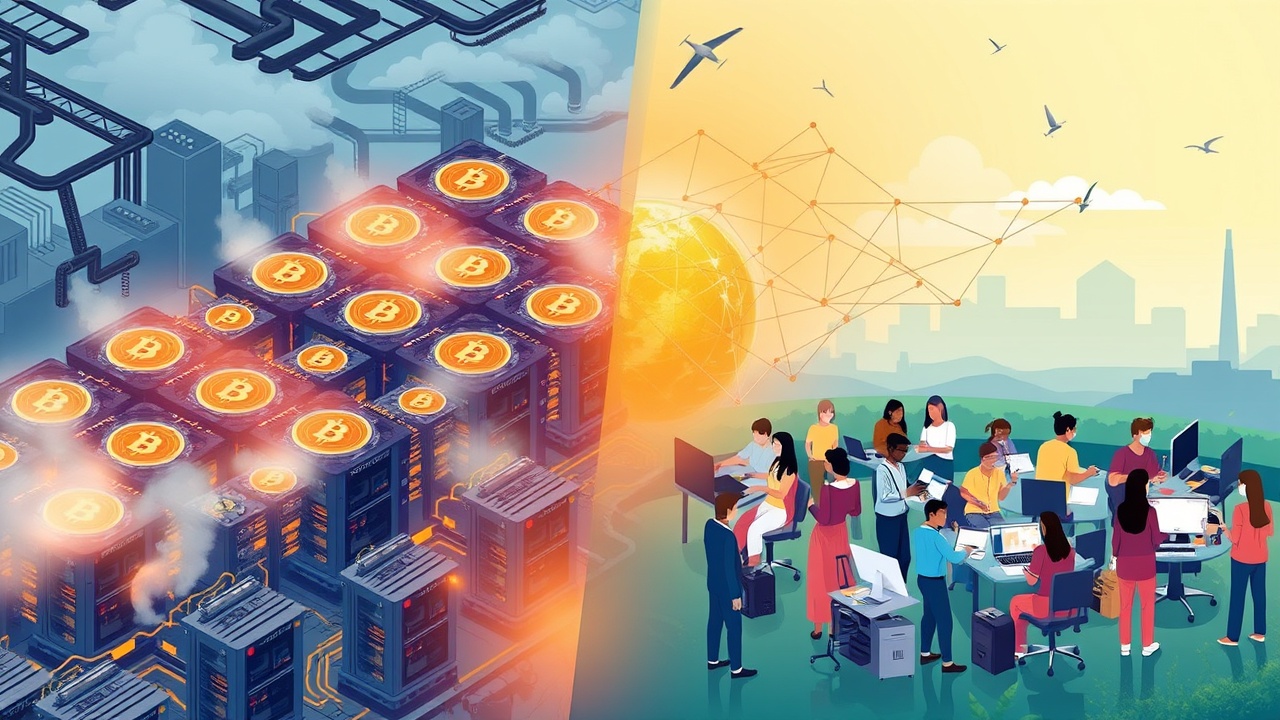
The Divergence of Bitcoin and AI
The worlds of Bitcoin and artificial intelligence (AI) are diverging in their approaches to power distribution, according to Alex Thorn, head of Galaxy Research. Thorn remarked that Bitcoin mining, which originally could be done on personal computers, has evolved into an operation dominated by large-scale industrial facilities equipped with specific hardware. In contrast, he predicts that AI development could undergo a reversal.
Potential for Localized AI
Currently, AI is primarily managed in large, centralized data centers. However, Thorn sees potential for more localized AI models as advancements in open-source initiatives enable them to become more compact, cost-effective, and efficient.
If these smaller models continue to evolve, we might witness a shift toward AI that is increasingly personal and device-based.
Market Growth and Implications
The shift toward localized AI has promising implications as indicated by a recent report from Grand View Research. They project that the Edge AI market—which allows applications to function directly on devices without relying on cloud storage—could skyrocket to $119 billion by 2033, up from an estimated $25 billion in 2025. This surge is largely driven by the proliferation of connected devices and the growing demand for immediate data processing capabilities.
The research firm attributes this trend to the expansion of the Internet of Things (IoT), highlighting how businesses are increasingly emphasizing data privacy and localized intelligence. Automating processes at the network’s edge helps prevent sensitive information from being transmitted to central servers, thereby enhancing user security.
Geographic Diversification in Bitcoin Mining
In a related development, a separate analysis from crypto exchange KuCoin revealed that while the cost and complexity of owning Bitcoin mining hardware have increased, the locations of such operations are becoming increasingly global. Factors such as skyrocketing electricity costs in the United States have driven miners to seek more affordable energy solutions in regions like Ethiopia and Paraguay, where abundant hydroelectric power is available.
KuCoin noted that this geographic diversification is crucial for the cryptocurrency’s resilience, explaining that it helps shield the network from risks associated with the political and energy infrastructures of single countries. Their report emphasized that
spreading out mining operations across different nations strengthens the network’s security and mitigates vulnerabilities related to political or environmental disturbances.