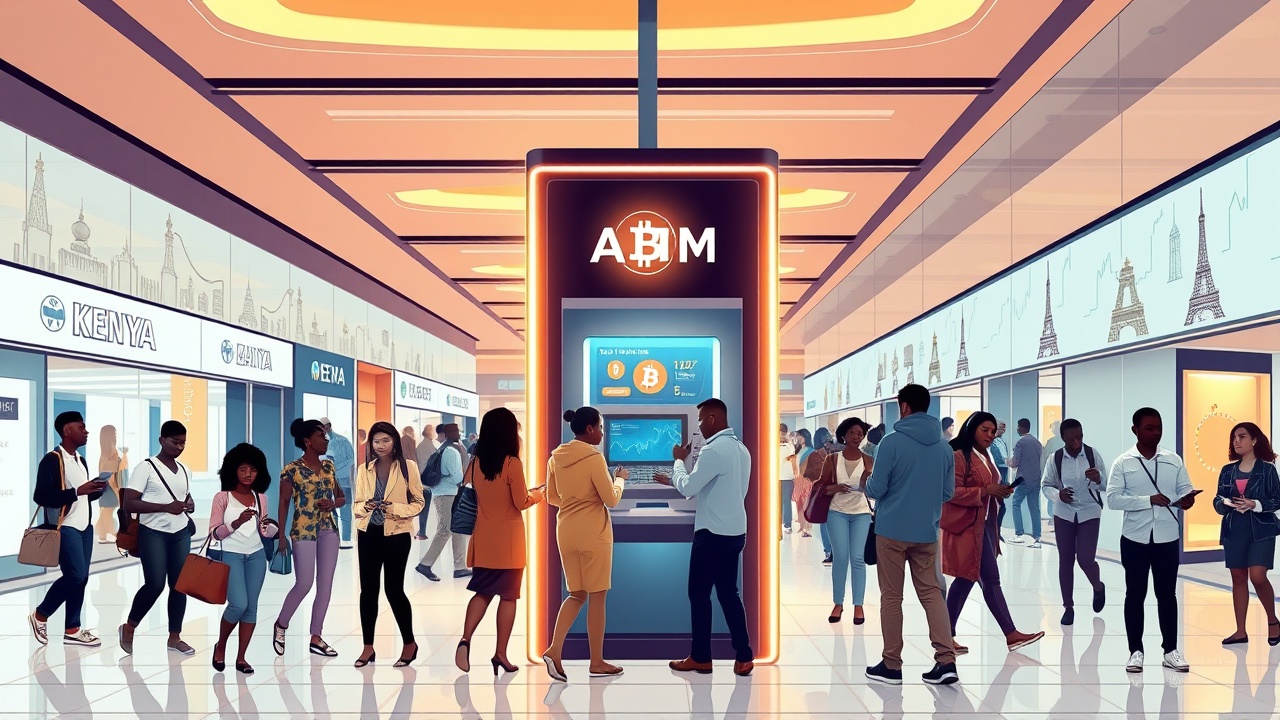
Emergence of Bitcoin ATMs in Nairobi
In a notable development following the introduction of Kenya’s inaugural cryptocurrency legislation, new Bitcoin ATMs have emerged in prominent shopping centers throughout Nairobi. This situation presents a significant challenge for regulators, who disclose that no cryptocurrency service providers have yet been authorized to conduct business within the country.
According to Capital News, machines branded as “Bankless Bitcoin” have recently been set up in several of Nairobi’s major malls, positioned alongside traditional banking options, allowing residents to exchange cash for cryptocurrency.
Historical Context and Current Landscape
Kenya has previously witnessed the installation of Bitcoin ATMs; in 2018, BitClub placed machines in Nairobi, but these did not gain substantial traction in the retail sector, leading to minimal adoption. Presently, data from CoinATMradar indicates that only two Bitcoin ATMs are officially recorded in the country.
Regulatory Framework and Challenges
The launch of these ATMs comes shortly after the enforcement of the Virtual Assets Service Providers Act of 2025 on November 4, which has established the first formal licensing structure for key crypto participants such as wallet operators and exchanges. Under the provisions of this new legislation, the Central Bank of Kenya (CBK) will hold oversight for payment and custody services, while the Capital Markets Authority (CMA) is tasked with the regulation of trading and investment activities.
Despite the existence of this framework, neither regulatory body has licensed any virtual asset service providers (VASPs) to operate in Kenya, creating a significant regulatory gap. In a statement issued on Tuesday, both the CBK and CMA emphasized that no VASP has received authorization under the recent laws, cautioning that any entity claiming to possess such licensure is acting unlawfully.
The CBK further noted that the National Treasury is in the process of formulating additional regulations necessary to initiate the licensing procedure.
Implications for the Kenyan Crypto Sector
This dissonance poses an interesting dilemma, as an increasing number of cryptocurrency infrastructures manifest in everyday retail venues while regulatory authorities caution against their unlicensed status. It raises pertinent questions concerning compliance and enforcement of regulations within the thriving Kenyan crypto sector.
Cryptocurrency in the Informal Economy
Interestingly, the advent of Bitcoin ATMs in upscale shopping malls reflects a broader integration of cryptocurrency in Kenya’s informal economy. As reported by Capital News, Bitcoin utilization is particularly prominent in less affluent regions like Kibera, where residents often resort to cryptocurrency as a vital banking alternative.
Ronnie Mdawida, co-founder of AfriBit Africa, noted that many in Kibera face challenges in securing traditional bank accounts, making Bitcoin an accessible means of preserving value despite the absence of formal documentation.
For these individuals, cryptocurrency represents not just a financial tool, but a pathway to economic freedom in their daily lives.