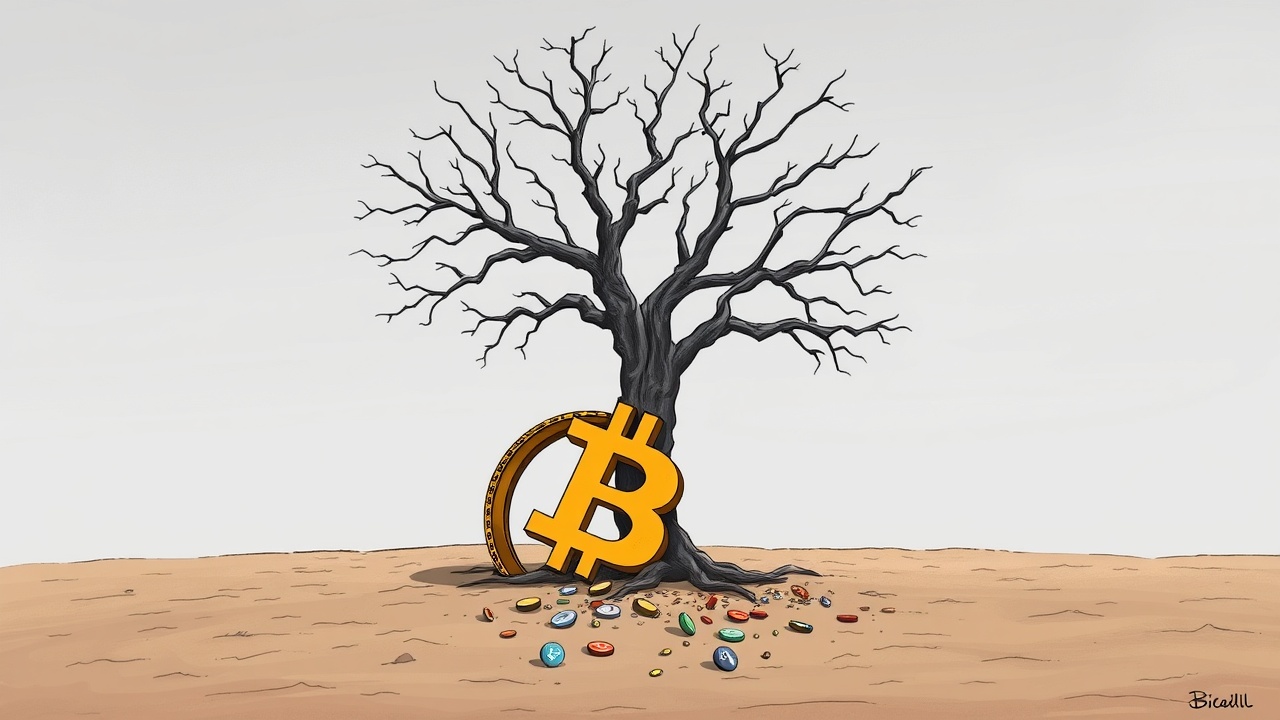
Bitcoin Chain Split Overview
Bitcoin has recently undergone a significant chain split, a situation foreseen by critics of the BIP-110 proposal, which has struggled to garner substantial backing from miners. The separation from the main ledger occurred at block 961,632, as reported by various Bitcoin analysts monitoring this development. Currently, the BIP-110 fork is lagging considerably, having achieved only block 961,633 while the primary Bitcoin network has already progressed to block 961,681, indicating a difference of 48 blocks between the two chains.
Block Production Rates
This disparity is substantial given that the usual rate of block production on the Bitcoin network is approximately one block every ten minutes. In stark contrast, the BIP-110 iteration is averaging a block creation time of about 6.9 hours, leading commentators to anticipate a continued decline in its viability. The majority of the mining community has thus far remained dedicated to the original Bitcoin chain, denying the BIP-110 version much-needed support.
Reactions from Industry Leaders
Adam Back, CEO of Blockstream and a veteran Bitcoin developer, has responded sarcastically to the situation, suggesting that those who forked off have discovered the limitations of their undertaking. Michael Saylor, Executive Chairman of Strategy and a prominent figure in the Bitcoin treasury space, echoed these sentiments, predicting that the fork would soon fade into obscurity. He noted that with minimal miner signaling of just 2.6%, BIP-110 was unable to rally enough miner consensus, which he articulated on X. According to Saylor, this lack of support means that the BIP-110 chain will inevitably either stall or become irrelevant while the main Bitcoin network persists as intended.
BIP-110 Proposal Details
The BIP-110 proposal aims to impose restrictions on the non-financial data that can be included in Bitcoin transactions, promoting the view that Bitcoin’s core function should be as a monetary system rather than a general-purpose platform for data storage. The proposal, put forth by the pseudonymous Dathon Ohm and supported by notable developer Luke Dashjr associated with Bitcoin Knots, has faced criticism from Bitcoin Core developers who argue that such restrictions would be ineffective. Indeed, in 2025, an increase to the OP_RETURN limit proposed by Bitcoin Core 30 shifted from a mere 83 bytes to a striking 100,000 bytes, reflecting the desire for more flexibility in the network.
Defense of BIP-110
Despite the challenges, Dashjr remains unwavering in his defense of BIP-110, labeling claims of its failure as misinformation. He directed his supporters to disregard what he characterized as harmful narratives surrounding the proposal’s potential demise and admitted that the block production rate of the BIP-110 chain was indeed slower, but he deemed this issue manageable.
“Not really. Blocks are slower, but that’s tolerable,”
he asserted, suggesting that the fork’s existence, albeit less efficient, should not yet be written off.