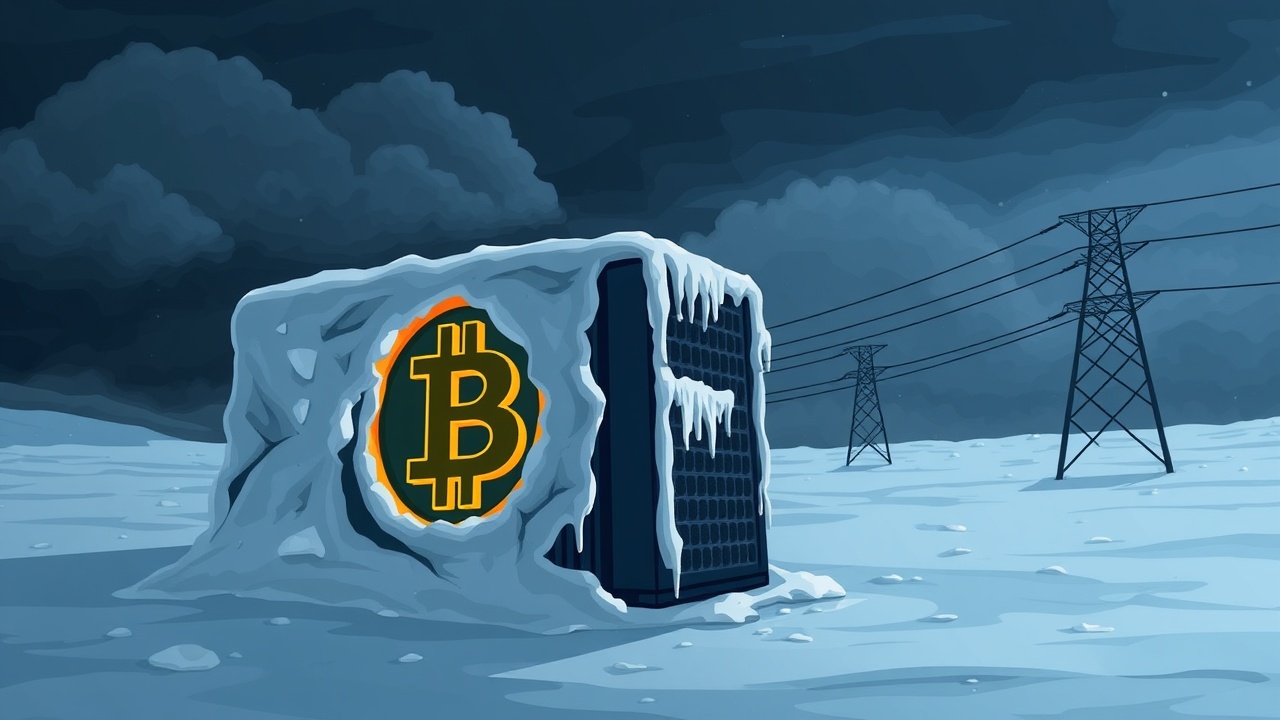
Impact of Winter Storm on Bitcoin Mining
Amidst a harsh winter storm this week, Bitcoin mining operations across the United States experienced a significant slowdown, which in turn affected network block times and temporarily decreased the overall hashrate. Mining pools based in the U.S. were particularly impacted due to the weather, which placed immense pressure on electricity supply systems in multiple regions.
Disruptions in Mining Pools
According to data from Mining Pool Stats, notable disruptions were seen at prominent pools like Foundry USA and Luxor, both of which are largely reliant on domestic grid conditions.
Specifically, Foundry reported a dramatic decrease in its hashrate, plummeting from approximately 260 exahashes per second (EH/s) on January 24 to about 124 EH/s the following day, with a partial recovery to around 134 EH/s observed by Monday. Similarly, Luxor’s hashrate fell from around 40 EH/s to about 16 EH/s within the same timeframe. Other mining pools also encountered varying declines, influenced by their geographical distribution; for instance, Antpool, which operates in the U.S. through a collaboration with Applied Digital, saw a drop from about 165 EH/s to 137 EH/s as of the latest updates.
Weather Conditions and Power Supply
The storm has been characterized as a significant winter weather event affecting vast regions across central and eastern United States, leading to prolonged freezing temperatures, snowfall, and icy conditions that stretched power grids thin and prompted utilities to temporarily cut power to large industrial consumers to maintain stability.
Expert Insights
Fakhul Miah, managing director at GoMining Institutional, emphasized that fluctuations in hashrate are commonplace due to various factors such as weather, power costs, and grid maintenance. “These temporary changes are absorbed by Bitcoin’s expansive network and its difficulty adjustment features,” he noted.
This incident underscores a transitional period for the Bitcoin mining sector, suggesting that these types of adjustments could soon become standard practice. Miah explained that Bitcoin mining has evolved into a more adaptable operation, capable of modifying energy consumption based on the requirements of contemporary power grids.
Callan Sarre, co-founder and chief product officer at Threshold Labs, remarked that the Bitcoin network has demonstrated resilience under stress. As concentrated hashrate from U.S. miners reduced during the storm, block creation intervals extended temporarily, only to revert to their normal pace after the situation stabilized.
He also highlighted the trend of miners functioning as a flexible energy load, especially in areas like Texas, where it appears that adjusting their energy use to align with residential demand has become part of the operational strategy for many mining entities. This allows them to earn revenue from demand-response initiatives while ensuring Bitcoin’s system remains stable and fully operational during such disruptions.