Economic Overview
In a recent segment of the Liberty Report, Ron Paul alongside co-host Chris Rossini painted a bleak picture of the U.S. economy, identifying it as ensnared in multiple financial bubbles stemming from impulsive government spending and the Federal Reserve’s easy monetary policies. They described this precarious state as an “everywhere bubble” or “everything bubble,” a term used by seasoned market analysts to define the interconnectedness of varying financial distortions.
Market Indicators and Investor Sentiment
Paul opened the discussion by analyzing certain market indicators that reveal widespread apprehension among investors. He noted that the price of gold remains stable at approximately $4,000 an ounce, and bitcoin has been experiencing significant fluctuations, which he sees as reflective of the declining trust in the dollar’s enduring value.
“Gold is indeed money,”
Paul stated, emphasizing its long-lasting purchasing power relative to other fiat currencies.
Artificial Intelligence and Economic Bubbles
The duo quickly turned their focus to the rapidly expanding artificial intelligence sector. Rossini compared the current frenzy surrounding AI to previous bubbles, which were similarly driven by the Fed’s lax monetary policies. He highlighted that the U.S. boasts over 5,000 data centers, a striking contrast to Germany, which has only 500—illustrating the scale of investment and energy consumption in this arena. Rossini referred to today’s economy as an “Alice in Wonderland” scenario, characterized by artificially low borrowing costs and misguided incentives.
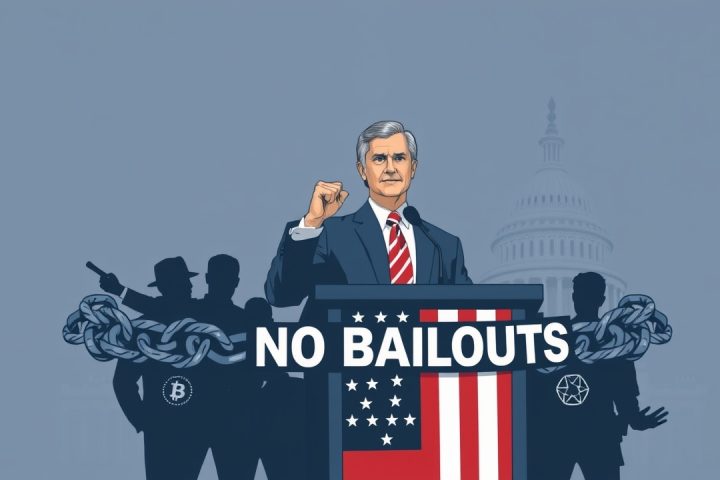
Citing comments from key tech executives who forecast an end to world poverty and assert their companies’ indispensability, Rossini likened such assertions to the misplaced optimism seen before the 2008 financial crisis, when home values were expected to continuously rise. Paul chimed in, explaining that the cycle of reckless credit growth paired with government interventions fosters a culture where risky behaviors are not only encouraged but later bailed out by taxpayers.
Inflation and Monetary Policy
Both hosts echoed that the bubbles—from the dot-com boom to the real estate crash and the current volatility in cryptocurrencies—emerge when accessible credit creates an illusion of wealth, which is not supported by real savings or production.
Paul articulated a pressing concern regarding the inflating money supply itself. He argued that Washington’s military expenditures and ongoing debt commitments have culminated in an economic model that relies on incessant money creation.
“Government spending is destined to be financed by printing money,”
Paul warned, declaring that inflation and currency devaluation are inevitable under current practices.
Economic Discrepancies and Future Outlook
The conversation highlighted perceived economic discrepancies, such as government incentives for electric vehicles and the faltering demand for commercial office spaces, alongside corporate reinvestment loops within the AI industry involving key players like Microsoft, Oracle, and Nvidia. They concluded that these economic phenomena persist solely because the price mechanisms fail to mirror genuine supply and demand.
Proposed Solutions and Conclusion
As a remedy, Paul urged for a shift back to a monetary system rooted in gold and silver, advocating for market transactions based on a stable unit of account. He referenced the Byzantine bezant, which served as an internationally accepted gold coin for centuries, as a model of enduring monetary reliability without the oversight of a central bank.
In his closing remarks, he expressed skepticism about the longevity of the U.S. dollar, noting historical patterns where every reserve currency has ultimately collapsed. However, he found hope in the rising interest among younger generations in monetary reform and alternative assets like gold and bitcoin. For the hosts of the Liberty Report, this growing curiosity represents a potentially promising shift in economic consciousness.