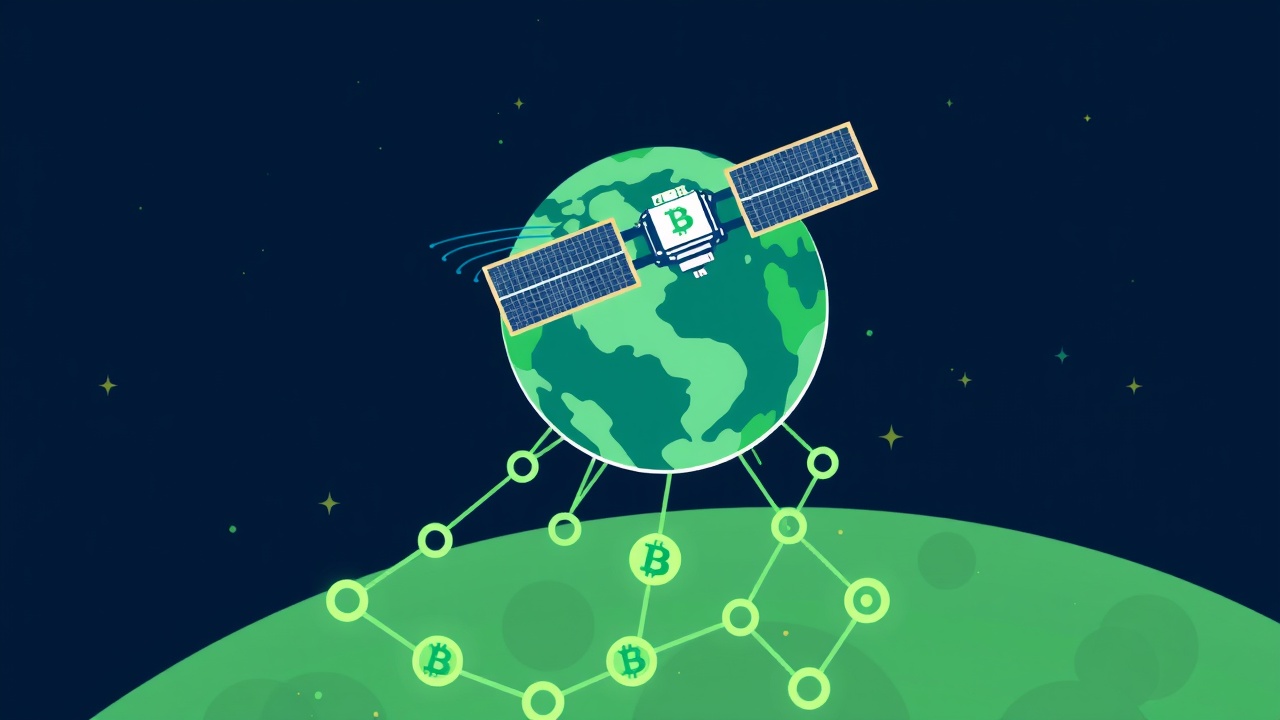
Bitcoin Mining in Space: A New Frontier
A company supported by Nvidia is set to initiate Bitcoin mining experiments in outer space later this year, spotlighting a pioneering venture to extend cryptocurrency operations beyond the confines of Earth. Established in 2024, Starcloud, a startup specializing in space infrastructure, plans to deploy Bitcoin mining equipment on an upcoming spacecraft launch scheduled for this year. If the initiative proves successful, it could usher in a significant shift towards orbital computing as a viable industry.
Starcloud’s Ambitious Goals
Philip Johnston, the CEO of Starcloud, took to social media platform X to announce the company’s objective to be the first entity to successfully mine Bitcoin beyond Earth’s atmosphere. He elaborated on this innovative concept during an interview with HyperChange.
This initiative is indicative of a broader trend as technology firms investigate the potential of utilizing space for data centers in response to the escalating global demand for computing power. Johnston highlights the economic benefits of positioning specialized Bitcoin mining devices in orbit, primarily due to the efficiency of the hardware used. Bitcoin mining operations leverage ASIC chips—dedicated processors that optimize hashing tasks and are known to be significantly more power-efficient compared to general-purpose AI hardware.
“A GPU costs about 30 times more to operate per kilowatt compared to an ASIC. For instance, an ASIC chip consuming 1 kilowatt costs approximately $1,000, while its GPU counterpart can run up to $30,000.”
This cost efficiency becomes particularly crucial in the high-expense environment of space, where lowering energy costs through optimized systems may lead to more practical computing solutions.
The Future of Mining and Energy
Moreover, Johnston believes that the profitability of Earth-based mining operations is diminishing. Currently, Bitcoin mining consumes around 20 gigawatts of global electricity. As energy availability becomes a pressing concern, he suggests that the industry may pivot towards solar energy solutions in space.
He envisions that space-based Bitcoin mining could blossom into a substantial sector over time. However, Starcloud’s ambitions extend beyond the world of cryptocurrency. Founded with the vision of constructing space-based data centers, the company aims to address the rising energy demands associated with artificial intelligence and high-performance computing.
Technological Innovations and Challenges
In a landmark event in November 2025, Starcloud successfully launched a satellite equipped with an Nvidia H100 GPU, a significant first for operating advanced AI technology in space. The company’s dreams include establishing an orbital network comprising approximately 88,000 solar-powered satellites, designed to facilitate both AI computing and Bitcoin mining operations.
Mindful of the larger implications, the concept of relocating crypto activities to space has ignited conversations about the feasibility of transactions across planetary distances. In September of last year, technology experts Jose E. Puente and Carlos Puente proposed that, with advancements in optical communication technologies akin to those developed by NASA and Starlink, Bitcoin transactions could potentially reach Mars in under three minutes. Their envisioned framework would necessitate a constellation of satellites and antennas, possibly supplemented by a relay node on the Moon.
Nonetheless, they caution that direct Bitcoin mining on Mars may be impractical due to the inherent communication delays between planets.
Legal and Market Considerations
Despite the burgeoning excitement around mining in orbit, it comes with significant legal and technical hurdles. The 1967 United Nations Outer Space Treaty stipulates that satellites fall under the jurisdiction of their home country, yet it remains ambiguous regarding taxation and regulation for cryptocurrency mined in space. Additionally, technical challenges persist; communications with Low Earth orbit satellites are contingent upon brief windows as they transit overhead, potentially creating disruptions in the transfer of mined Bitcoin to the network.
As these ambitious space ventures capture the spotlight, traditional Bitcoin miners are still grappling with a challenging market. Bitcoin has experienced a dramatic price drop of nearly 48% from its record high of $126,080 in October, though a recent 7% dip in mining difficulty has provided some respite for operators. At this time, Bitcoin mining is firmly rooted on Earth, but the successful experiments by Starcloud could mark the dawn of a new era, with Bitcoin first venturing beyond our planet.