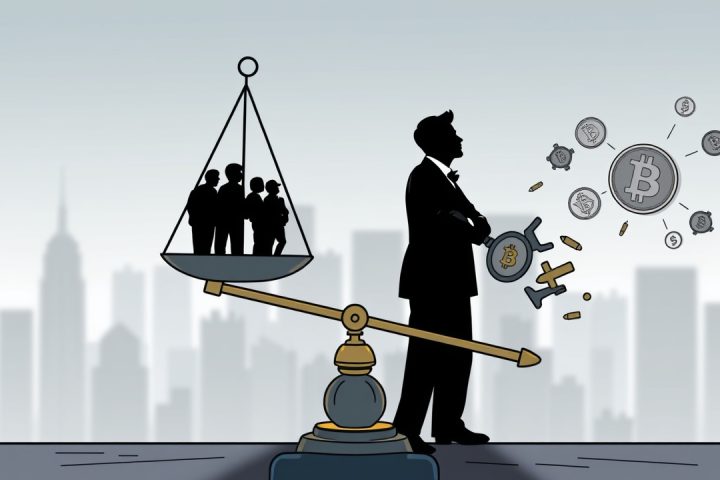
IMF Concerns on Stablecoins
The International Monetary Fund (IMF) has raised alarms regarding the nature of stablecoins, arguing that they bear a closer resemblance to money market funds than traditional currency and could be susceptible to panic-driven withdrawals as the landscape of tokenized finance continues to grow. Tobias Adrian, who serves as the financial advisor and director at the IMF’s monetary and capital markets unit, noted in a recent publication that the introduction of tokenization in finance redefines the trust dynamics within the system.
Tokenization and Financial Infrastructure
Adrian elaborated that conventional financial infrastructures often involve processes such as end-of-day settlements and batch processing, which afford regulators the necessary time to intervene during potential disruptions. In contrast, tokenization allows for continuous and automated settlements, which could trigger liquidity crises instantaneously without the opportunity for regulatory response.
This tension results in a dissonance between the rapid operational pace of tokenized platforms that function seamlessly across international borders and the slower, jurisdiction-bound crisis management strategies currently in place. The IMF suggests that the mechanisms of control in the realm of tokenized finance might be entrenched more in coding and system governance than in institutional oversight.
Proposed Strategies for Regulation
In light of these findings, Adrian proposed a comprehensive five-pillar strategy aimed at governments to secure tokenized settlements with reliable assets, such as wholesale central bank digital currencies, enforce uniform regulations across analogous activities, and modify central bank liquidity provisions for automated trading environments. The report emphasized that any legal requirements for financial stability should take precedence over automated operations, recommending the implementation of compulsory audits and override systems for critical smart contracts to enable intervention in emergencies.
Broader Context of Digital Asset Risks
This latest note is part of the IMF’s broader series of warnings regarding digital asset risks. The organization previously criticized private cryptocurrencies as an unreliable means to achieve financial inclusion and collaborated with the Financial Stability Board to address the threats posed by cryptocurrency to financial stability. Most notably, the IMF cautioned in late 2025 about the potential for widespread stablecoin usage to undermine central bank authority.
Expert Opinions on the Framework
Experts, including Siwon Huh from Four Pillars, acknowledged the document’s significance, though they pointed out shortcomings. Huh indicated that the framework’s approach might mislead policymakers into believing that the existing system is secure without adequately comparing it to the risks associated with traditional financial practices, which also harbor vulnerabilities.
Further, major stablecoins like USDT and USDC are backed by reserves such as U.S. Treasuries, cash, and reverse repos, rendering them similar to prime money market funds, but without the same regulatory protections, as noted by Huh.
Perspectives from the Fintech Industry
Alan Qureshi, CEO and co-founder of fintech company Black Lake, remarked that stablecoins do not aspire to emulate central bank currency. Rather, they provide investors access to secure, highly liquid assets, while offering liquidity mechanisms for issuers and banks. He highlighted that regulated stablecoins, underpinned by quality assets, serve as localized liquidity reservoirs that effectively distribute collateral.
Concerns regarding cross-border resolution and the interplay between speed and regulatory oversight are valid, yet Qureshi believes these characteristics are intentional strengths of a system intended to operate more swiftly than its traditional counterparts. Similarly, Neil Staunton, CEO of fintech startup Superset, concurred with the report’s observations but cautioned that such warnings could inadvertently hinder the essential development of infrastructure aimed at enhancing stability. He argued that tokenized systems leverage cryptographic technologies and real-time validation as effective tools, rather than inferior alternatives, noting that established exchanges like the NYSE and Nasdaq are already progressing with the coordinated infrastructure outlined by the IMF.