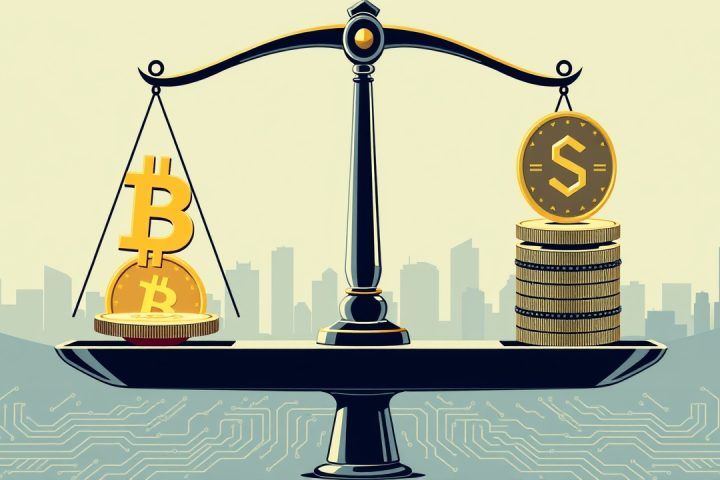
Bitcoin vs. Traditional Assets: A Critical Analysis
In a recent online discussion, well-known investment analyst Peter Schiff has pushed back against the belief that Bitcoin serves as a viable, inflation-proof ledger for the preservation of economic energy. This critique specifically targets the perspective of Bitcoin advocates, particularly Michael Saylor, CEO of MicroStrategy, who often claims that money can be classified as “economic energy.”
Saylor explains that by working, individuals expel energy, which is then stored as money for future use. He believes that whereas traditional fiat currency is subject to depreciation—”leaking” this energy—gold presents challenges in terms of mobility, thus positioning Bitcoin as a form of “digital energy.” It is essentially viewed as a type of battery that retains economic contributions without loss over time and allows for rapid transactions globally.
Support from Tech Industry Leaders
This viewpoint is echoed by other prominent figures in the tech industry, such as Tesla’s Elon Musk, who considers Bitcoin a “fundamental physics-based currency” due to its dependence on energy consumption. Musk has even speculated about a future where traditional money no longer exists, envisioning a society defined by artificial intelligence and robotics, where scarcity is a thing of the past.
Schiff’s Counterarguments
However, Schiff articulates a crucial distinction, pointing out that Bitcoin cannot reverse the energy expenditure used during its mining process—once it’s created, that energy is permanently consumed. In the event of a power outage, the value of one Bitcoin does not translate into any usable energy, reinforcing Schiff’s argument that Bitcoin, in its essence, fails to serve as a true store of energy.
The Value of Gold
In contrast, while gold mining also requires significant energy—derived from sources like diesel and electricity—Schiff maintains that this energy is not wasted. Instead, it is transformed into a tangible metal that fulfills numerous industrial needs, such as electronics, aerospace, dentistry, and jewelry. Thus, he argues that the energy utilized in gold mining results in a practical product, unlike Bitcoin.