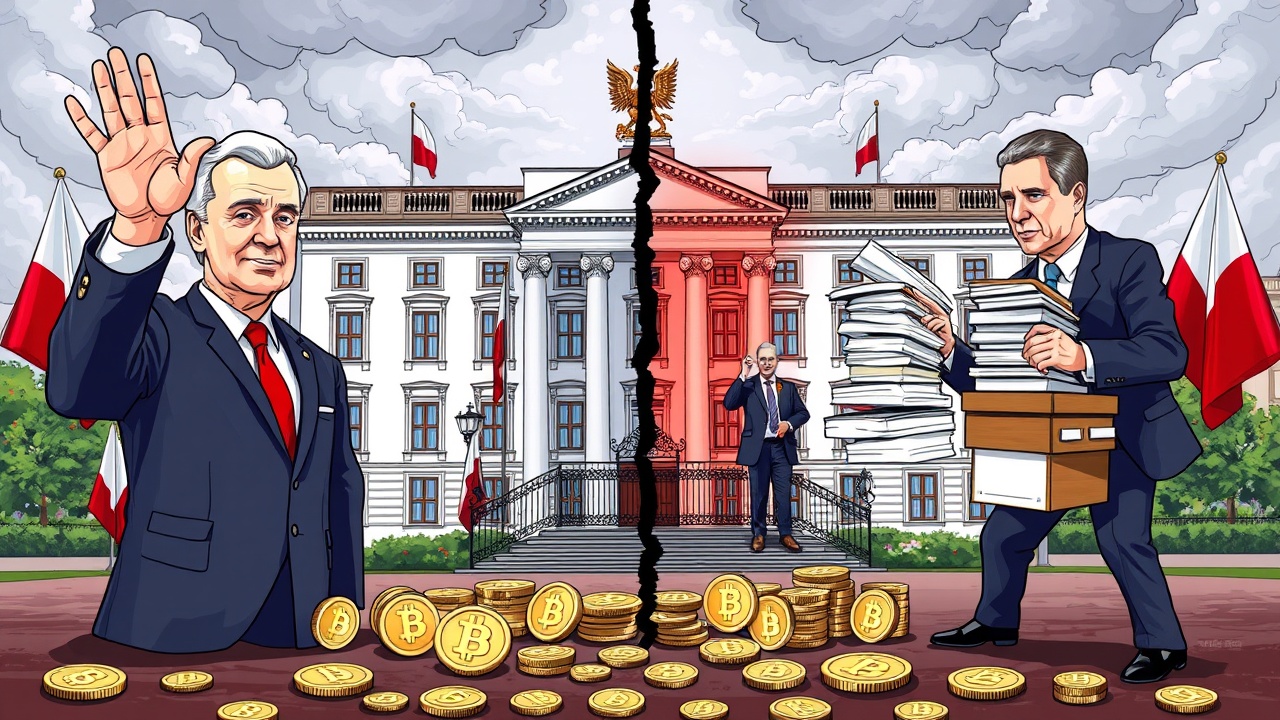
Poland’s President Vetoes Controversial Crypto Legislation
In a significant move for the cryptocurrency landscape, President Karol Nawrocki of Poland has opted not to endorse a controversial piece of legislation aimed at tightening regulations on the crypto asset sector. This decision has garnered enthusiastic support from the cryptocurrency community while inciting criticism from various government leaders.
The Crypto-Asset Market Act
The Crypto-Asset Market Act, which was proposed in June and recently passed through parliamentary approval, was ultimately vetoed by Nawrocki. The president’s office released a statement explaining that certain aspects of the legislation posed a “genuine threat to the liberties of Polish citizens, their possessions, and the nation’s overall stability.”
Reactions to the Veto
Critics of the law, including Polish politician Tomasz Mentzen, had already expressed concerns about its implications, predicting Nawrocki would reject it. Supporters of the veto have framed it as a progressive step for the country’s crypto environment. However, detractors from within the government have lambasted the president’s decision, asserting that he has opted for disorder and must be accountable for the repercussions.
Key Objections to the Legislation
Nawrocki’s main objections focused on a clause that granted authorities the ability to easily block crypto-related websites. The president’s office emphasized that such domain-blocking measures are ambiguous and susceptible to misuse. Additionally, the administration criticized the law’s complexity, which they believe would compromise transparency and lead to excessive regulation, especially when compared with the more straightforward regulatory frameworks found in neighboring countries like the Czech Republic, Slovakia, and Hungary. The president warned that this overregulation could result in Polish-based companies relocating to more favorable tax environments abroad.
Further underscoring his concerns, Nawrocki pointed out that the high supervisory fees imposed by the proposed law could stifle innovation and deter startups, instead favoring larger foreign entities in the financial sector. He remarked,
“This is fundamentally counterproductive, hindering a competitive marketplace.”
Backlash from Government Officials
The veto has provoked backlash from high-ranking officials, including Finance Minister Andrzej Domański and Deputy Prime Minister Radosław Sikorski, who voiced strong disapproval on social media. Domański claimed that a substantial number of clients are currently losing money due to exploitation in the crypto space, asserting that the president has “chosen chaos.” Sikorski added that the intention behind the proposed regulations was to safeguard the crypto market and warned of the consequences if the bubble were to burst, suggesting Nawrocki would be to blame for any ensuing financial distress among investors.
Support for the Veto
In contrast, proponents of the veto, such as economist Krzysztof Piech, contended that the president should not be liable for the inaction of regulatory authorities against fraud. They also mentioned that forthcoming European Union regulations (the Markets in Crypto-Assets Regulation or MiCA), which will take effect on July 1, 2026, are anticipated to offer crucial protections for crypto investors across EU member states.