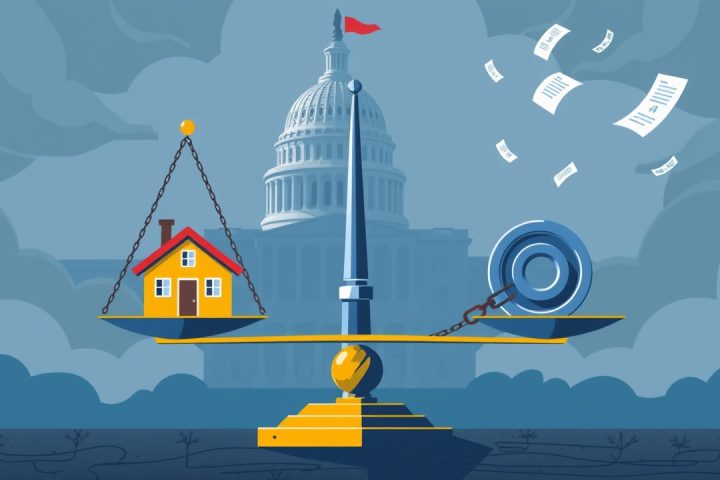
Collaboration Between SEC and CFTC
The Securities and Exchange Commission (SEC) and the Commodity Futures Trading Commission (CFTC) have officially established a collaborative agreement aimed at consolidating their regulatory oversight regarding financial markets and digital assets. This memorandum of understanding is a strategic initiative to enhance coordination in rulemaking, supervision, and enforcement where their jurisdictions intersect. The leaders of the two agencies have framed this agreement as a crucial step in addressing the longstanding issue of fragmented oversight that has hindered innovation in the financial sector.
Joint Harmonization Initiative
“Regulatory conflicts and duplicated registration processes have plagued us for years, limiting growth and driving market participants to more favorable jurisdictions,” stated SEC Chairman Paul Atkins.
In a move to address these challenges, the agencies have introduced the “Joint Harmonization Initiative,” which will tackle various critical issues including defining products, creating clearing regulations, and establishing consistent reporting demands across trading platforms.
Unified Regulatory Framework
CFTC Chairman Michael Selig emphasized that the aim of this initiative is to create a unified regulatory framework that fosters seamless oversight of financial markets.
The groups identified key areas for collaboration, including the need for clearer product classifications, modernization of clearing and margin regulations, and simplification of reporting requirements for various financial intermediaries and funds. A particular emphasis is placed on establishing a practical regulatory structure for cryptocurrencies and other emerging technologies.
Impact on the Financial Sector
The combined efforts of the SEC and CFTC are expected to pave the way for more cohesive policymaking in anticipation of broader legislative action on the crypto ecosystem by Congress. Industry leaders perceive this strengthened coordination as a pivotal moment for the financial sector, especially for firms navigating the complexities of digital assets.
Steven Wu, the Chief Operating Officer of Clearpool, pointed out that the uncertainty surrounding token classifications and jurisdiction has been a significant obstacle for companies in the digital asset space. He noted that clearer regulatory guidance would enable firms to innovate confidently, potentially accelerating the inclusion of institutional capital into this market.
Wu explained, “A clear, aligned framework will reduce ambiguity, allowing businesses to introduce new financial products with assurance.”
Regulatory Compliance Simplification
The lines distinguishing spot markets, derivatives, and tokenized products are rapidly fading, leading many firms to simultaneously interact with both regulatory bodies. This often results in overlapping approval processes and added uncertainty for compliance. Wu added, “With closer alignment between the SEC and CFTC, we could simplify how regulatory compliance is achieved, potentially allowing firms to satisfy both agencies under one set of requirements, thus speeding up product deployment.”
Future Implications
The implications of this agreement, announced on Wednesday, could encourage firms weighing the pros and cons of operating within the U.S. versus offshore. A clearer compliance landscape might render the U.S. a more attractive option. Samar Sen, the head of international markets at Talos, noted that this collaboration could eliminate the mismatch within the regulatory frameworks that previously complicated operations for institutional players engaged in various segments of the digital asset market.
He pointed out that such fragmentation typically resulted in additional burdens due to differing supervisory expectations and reporting obligations for similar activities. With the SEC and CFTC working together, the industry can look forward to reduced duplications in the approval processes, leading to a more coherent structure that supports the growth of new financial products without unnecessary regulatory hurdles.