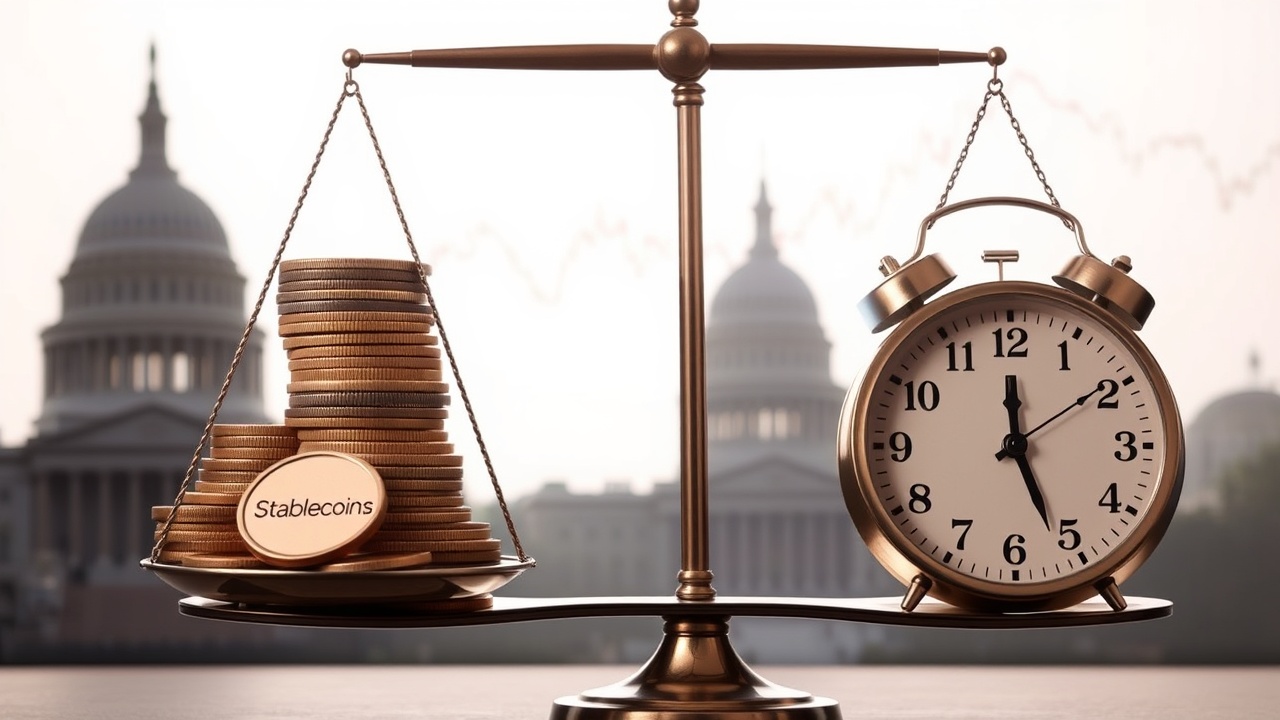
Senator Tim Scott’s Anticipation of Stablecoin Yield Agreement
Senator Tim Scott, a Republican from South Carolina and chairman of the influential Senate Banking Committee, indicated on Tuesday that he anticipates a potential agreement regarding the contentious topic of stablecoin yield could emerge by the end of this week. Speaking at the DC Blockchain Summit, Scott remarked,
“I expect to have the first proposal in my hands for review this week.”
According to a source close to the situation, the White House may provide an update as early as tomorrow.
Market Structure Bill Stagnation
The market structure bill, which has been highly sought after in the cryptocurrency sector, has been stagnated in the Senate for months. While the House of Representatives passed its own version, known as the Clarity Act, last summer with considerable bipartisan backing, progress in the Senate has been impeded due to objections from both parties on key aspects.
If passed, the market structure bill would solidify the legal status of most cryptocurrency activities at the federal level, offering a buffer for the industry against the possibility of stringent regulations from future presidential administrations that may be less favorable toward crypto. It would enable U.S. companies to market blockchain-based tokens to retail investors—something the SEC, under Chair Gary Gensler during the Biden administration, has been attempting to curb through various enforcement actions.
Current Deadlock and Industry Concerns
The current deadlock concerning the bill revolves around stablecoin yield. Companies like Coinbase provide yield on stablecoin holdings—tokens designed to maintain a value equivalent to the U.S. dollar. Although the GENIUS Act, enacted by President Trump last year, did not prohibit these yield programs, banking lobbyists are now advocating for their prohibition, citing the potential adverse effects on traditional, low-return bank accounts.
The situation intensified earlier this year when, just before a crucial Senate Banking Committee vote on the market structure bill, Coinbase retracted its support amid worries that the legislation could restrict stablecoin rewards. Consequently, the planned vote was canceled and has not been rescheduled since. Following this, the White House facilitated several discussions between representatives from the cryptocurrency and banking sectors, aiming for a resolution by March; however, these talks have since stalled.
In response to the backlash, Senators Thom Tillis (R-NC) and Angela Alsobrooks (D-MD) have sought direct engagement with Senate leadership and the White House regarding the issue of yield on stablecoins. Industry officials and lawmakers alike are voicing concerns that the opportunity to pass the legislation is dwindling as Congress heads into the 2026 midterm election cycle.
“Time is not on our side,” stated Rep. Dusty Johnson (R-SD), who chairs the House Agriculture Digital Assets Subcommittee, at the same summit where Scott spoke. Johnson noted that the Senate may only have around six weeks left to finalize the market structure bill, expressing worries that if the situation continues to drag, setbacks could happen unintentionally.
Impact on Cryptocurrency Firms and Future Challenges
Furthermore, Pierre Yared, the acting chair of the president’s Council of Economic Advisors, highlighted the significant impact that the resolution of the stablecoin yield issue could have on cryptocurrency firms such as Coinbase. He suggested that while the consequences for the banking sector may be minor, they could be substantial for stablecoin adoption depending on the outcome of the yield discussions.
Even if a resolution regarding yield is resolved swiftly, other challenges will still need addressing for the Senate’s crypto market structure bill to advance. These challenges include concerns raised by several Senate Democrats over the Trump family’s direct involvement in various crypto ventures and calls to restrict these activities under the proposed legislation. The White House considers such limitations as non-negotiable.
Additional hurdles involve decentralized finance (DeFi) platforms, which operate independently on blockchain networks and eliminate the reliance on traditional financial intermediaries. Many industry participants have expressed intentions to withdraw their support for the bill if Senate Democrats pursue demands related to national security that would eliminate exemptions for DeFi projects. Noting these ongoing challenges, Scott expressed hope that solutions could be reached in time, stating,
“Let us pray.”