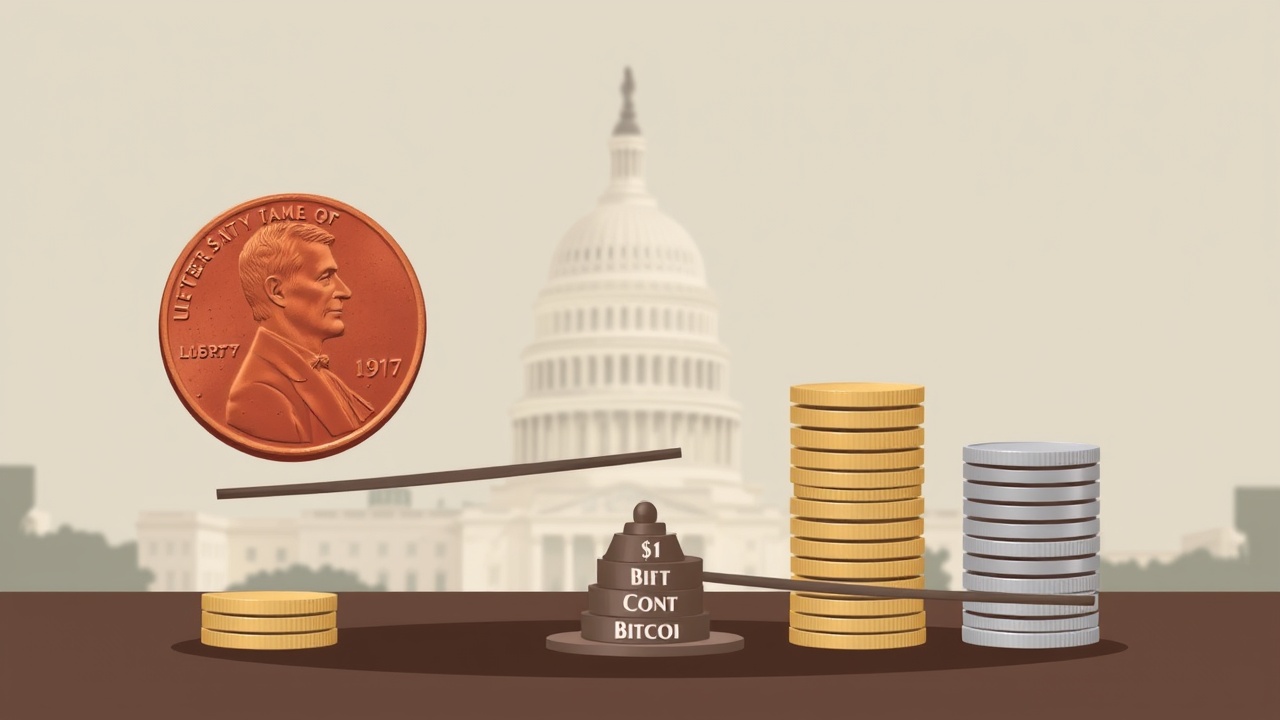
The End of Penny Production
The United States Mint has officially produced its last penny, concluding a remarkable 232-year era of penny manufacturing and distribution. This significant change follows a directive from former President Donald Trump, who advocated for the cessation of penny minting, originally slated for 2026. Compounding this decision, the U.S. Treasury exhausted the necessary templates for producing these coins between June and September, according to reports by Axios.
The Cost of Minting Pennies
Currently, the expense associated with creating a penny far exceeds its value, as it costs approximately $0.03 to produce each coin—about 3.7 times its worth. Even though the minting of new pennies will stop, the existing over 250 billion pennies in circulation will remain legal tender.
The Rise of Digital Currencies
In light of this transition, industry experts are drawing attention to the growing preference for digital currencies like Bitcoin. Alexander Leishman, CEO of financial services firm River, noted that inflation has significantly undermined the utility of pennies while enhancing the demand for Bitcoin’s fractional units known as “sats”. Bitcoin was designed fundamentally as an alternative to conventional currency, with a maximum supply limited to 21 million coins. As interest in Bitcoin increases, many believe its value will also rise in response.
Economic Perspectives on Currency
Saifedean Ammous, a respected economist and Bitcoin proponent, highlights that advances in technology tend to exert deflationary pressure, thereby improving production efficiencies and leading to lower prices for goods and services. In contrast, fiat currencies fail to reflect this deflation since they can be produced in unlimited amounts, ultimately experiencing a loss in purchasing power. He posits that if goods and services were priced in stable monetary forms, we would likely see decreasing prices over time. For instance, measuring median home prices in Bitcoin suggests that holders would benefit from the deflationary character of a capped monetary supply.
Concerns About the U.S. Dollar
The Gold Bureau emphasizes concerning trends, noting that the U.S. dollar has lost over 92% of its value since the inception of the Federal Reserve system in 1913. Bitcoin recently reached more than $126,000, according to market analysts from The Kobeissi Letter, while the U.S. dollar has faced unprecedented challenges, manifesting its worst performance in decades—losing around 40% of its purchasing power since the year 2000, including a 10% decline just this year.
Debate on Cryptocurrency Usability
In contrast, economist Paul Krugman remains skeptical about cryptocurrencies, arguing that the practical usability of the dollar far surpasses that of Bitcoin. Krugman insisted, during a podcast with Hasan Minhaj, that
“the whole point about the dollar is it’s really easy to use, and Bitcoin is not easy to use.”
This highlights an ongoing debate surrounding the practicality of digital currencies in everyday transactions compared to traditional currency.