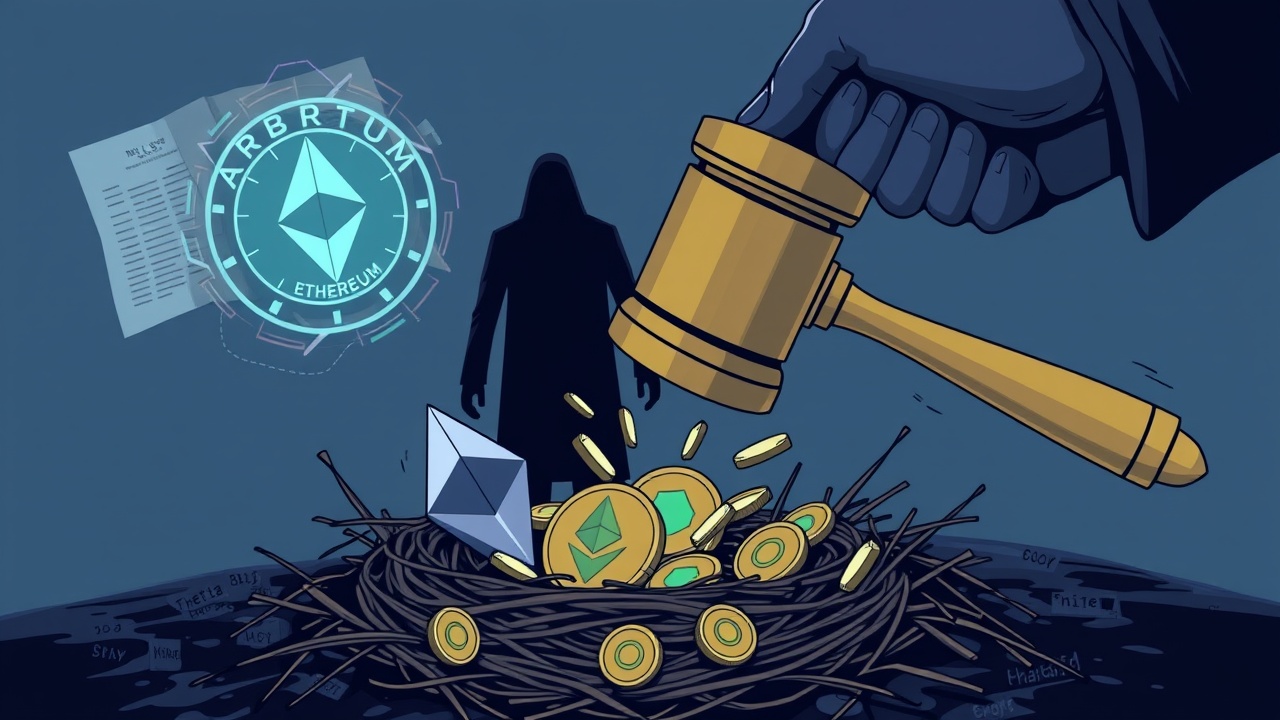
Legal Ruling Halts Arbitrum DAO’s Fund Plans
A recent ruling by a U.S. District Court in New York has effectively put a halt to the Arbitrum DAO’s intentions regarding a significant pool of frozen funds previously linked to a security breach. This legal action centers around the 30,766 ETH, amounting to approximately $71.1 million, which was secured by the Arbitrum Security Council following an attack that exploited Kelp DAO’s platform.
Background of the Case
The plaintiffs involved in this case are individuals with outstanding terrorism-related judgments against North Korea, specifically regarding accusations tied to the Lazarus Group, believed to have perpetrated the hack on North Korea’s behalf. These individuals argue that the seized cryptocurrency is essentially property connected to North Korea and should remain frozen due to its links to their claims under U.S. law.
Arbitrum DAO’s Response
The Arbitrum DAO responded to the exploit on April 20, moving the ETH to a controlled wallet after identifying addresses associated with the attackers. Subsequent communications from Arbitrum indicated that this precautionary measure was taken in conjunction with law enforcement guidance, ensuring that regular user operations on the platform were not disrupted.
Plaintiffs’ Claims
Represented by Gerstein Harrow LLP, the plaintiffs, Han Kim and Yong Seok Kim, base their claims on various court judgments, including a notable $330 million award related to the death of Reverend Kim Dong-shik at the hands of North Korean operatives. Their combined claims, which also reference additional cases against North Korea, exceed $877 million before accruing interest.
The concepts presented in their legal argument utilize the Foreign Sovereign Immunities Act and the Terrorism Risk Insurance Act, which grant them the ability to lay claim to assets associated with states involved in terrorism. The court filing explicitly mentions both the Lazarus Group and APT-38 as affiliated organizations of North Korea, reinforcing their position.
Governance Vote and Future Implications
Amidst these developments, the Arbitrum DAO had initiated a governance vote on April 30 to decide the fate of the frozen ETH, aiming to allocate it toward a recovery initiative. This proposal, envisioned by Aave Labs with input from other contributors, sought to manage the funds in a secure multi-signature wallet controlled by community members and the security firm Certora. The vote revealed overwhelming support, with 99% in favor, although the final decision remains to be influenced by the court’s ongoing orders.
Included within the proposal was an indemnification clause designed to protect Arbitrum’s Foundation and others from claims resulting from the handling of the funds; however, the effectiveness of this clause in the context of the current legal restrictions remains unclear.
Broader Context of Cryptocurrency Security
This situation stems from an earlier exploit that drained Kelp DAO of 116,500 rsETH, a theft valued at $292 million, identified to be the result of a compromise in their LayerZero bridge infrastructure. The attack illustrates a broader issue, as North Korean-backed cryptographic thefts have been reported at nearly $600 million in just the first quarter of this year. The complexities surrounding this case reflect both the challenges involved in securing digital assets and the legal intricacies that can arise when state-sponsored terrorism becomes a factor in cryptocurrency transactions.