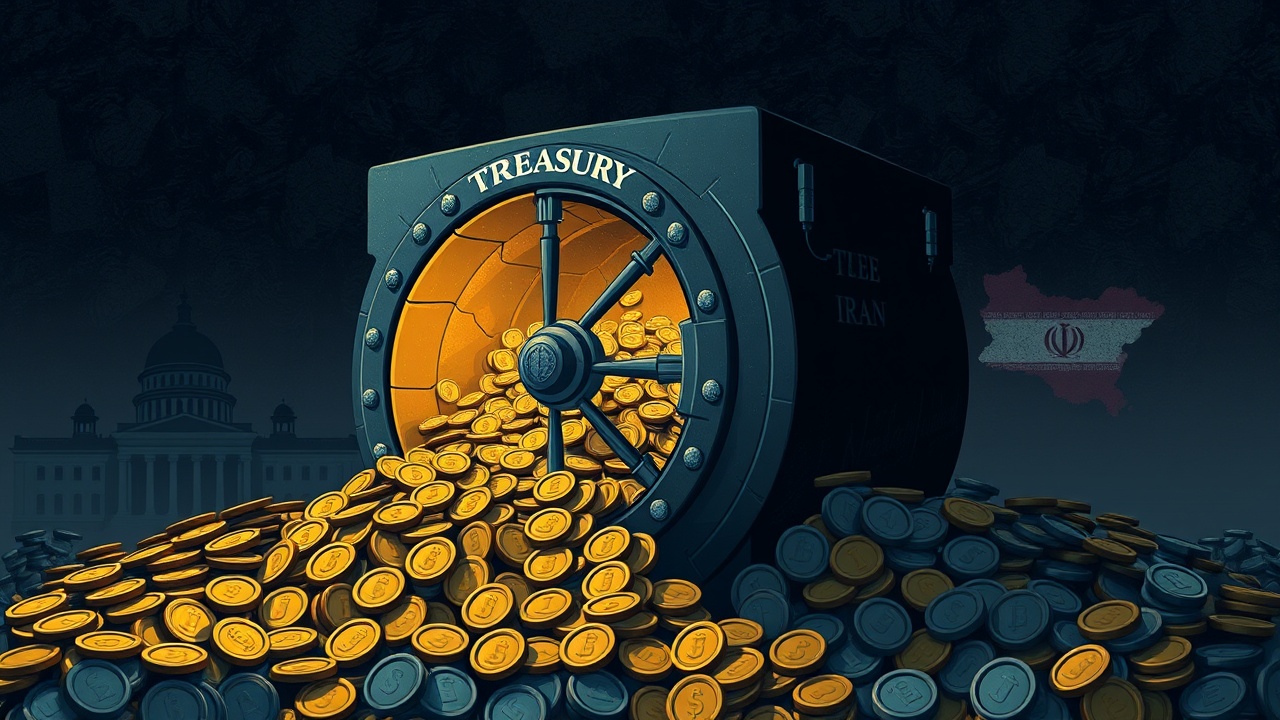
U.S. Treasury Sanctions Cryptocurrency Exchanges
In a significant move targeting illicit financial operations, the U.S. Treasury Department has imposed sanctions on two cryptocurrency exchanges believed to have laundered millions of dollars for Iran’s Islamic Revolutionary Guard Corps (IRGC). The action, announced on August 7 under the initiative dubbed “Economic Fury”, highlights the Iranian regime’s increasing reliance on digital currencies and covert banking systems, a fact underscored by Treasury Secretary Scott Bessent.
Details of the Sanctions
The sanctions focus on Siavash Kayvanpour, an Iranian national who holds citizenship in both Dominica and Afghanistan. Kayvanpour is alleged to have orchestrated a complex international operation from his bases in the United Arab Emirates and Georgia through a company named SHPS Shelbit, managing the Shelbit Exchange. According to Treasury officials, there is evidence that Iranian military-linked cryptocurrency wallets transmitted over $1 million in funds to Shelbit, which in turn transferred more than $2 million back to those wallets, and additionally funneled $2 million to Nobitex—a previously sanctioned Iranian exchange linked to terrorist financing.
Moreover, Treasury claims that Shelbit was utilized to launder tens of millions of dollars generated from a Persian-language online gambling network. The United Arab Emirates’ Virtual Assets Regulatory Authority had previously taken action against Shelbit General Trading in January 2025 and July 2026, yet the exchange continued operations.
Additional Sanctions and Implications
Alongside Shelbit, the Treasury also sanctioned another exchange, Aban Tether, which processed substantial transactions with other Iranian entities, including Nobitex, Wallex, Bitpin, and Ramzinex, all of which have been previously designated for their involvement in Iran’s financing of terrorism.
Both exchanges have been added to the Specially Designated Nationals (SDN) List, effectively blocking them from engaging in any transactions involving U.S. financial systems. This designation means that any assets within U.S. jurisdiction are frozen, and foreign businesses dealing with these exchanges could face secondary sanctions. To further disrupt financial support for the IRGC, the State Department’s Rewards for Justice program is offering up to $15 million for information that could aid in breaking down the financial networks supporting the IRGC.
Ongoing Campaign Against Iran’s Crypto Reliance
The U.S. campaign against Iran’s crypto reliance has been persistent; notably, in May, authorities froze $131 million linked to Iranian cryptocurrencies and have reportedly seized around $1 billion in total since the campaign’s inception. As of the latest updates, the entities and individuals associated with Shelbit Exchange and Aban Tether are officially on the SDN List, marking a critical step in the ongoing effort to combat financial crimes associated with Iran’s military apparatus.