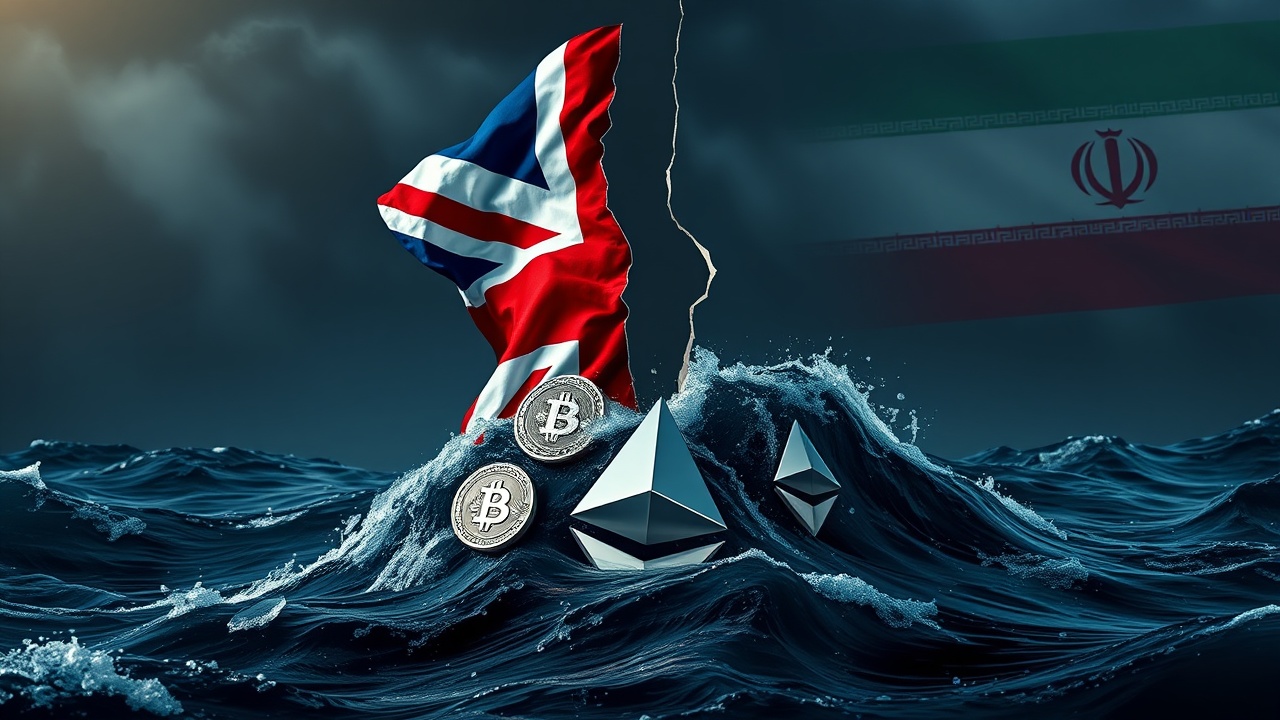
Regulatory Action Against Zedxion Exchange Ltd.
In a significant regulatory move, Companies House, the UK’s official corporate register, is proceeding with the dissolution of Zedxion Exchange Ltd., a cryptocurrency platform implicated in financial dealings with Iran’s Islamic Revolutionary Guard Corps (IRGC). This decision, publicly announced through the entity’s website, is tied to U.S. sanctions introduced in January by the Office of Foreign Assets Control (OFAC), which designated Zedxion and its affiliated firm, Zedcex, for their suspected involvement in facilitating Iran’s evasion of international sanctions and connections to the controversial financier Babak Zanjani.
Allegations and Investigations
Companies House stated that their decision to dissolve Zedxion arose from allegations of misleading or false information during the company’s registration process. Investigations led by the Organized Crime and Corruption Reporting Project raised concerns that Zedxion’s declared director, Elizabeth Newman—a Dominican national according to corporate filings—may be a fabricated identity. Notably, Newman was associated with a stock image used in marketing materials, casting further doubt on her credibility.
Financial Transactions and Links to IRGC
Analysis by TRM Labs, a blockchain analytics company, revealed alarming figures: Zedxion and Zedcex reportedly processed around $1 billion in transactions tied to the IRGC, representing 56% of their total operations. The proportion of these IRGC-related transactions even surged to 87% in early 2024, when linked inflows reportedly peaked at approximately $619.1 million, before dipping to about 48% in 2025.
Background on Babak Zanjani
Zedxion Exchange Ltd. was initially incorporated in May 2021. Later that same year, an individual named “Babak Morteza” became the company’s director and person of significant control. This name corresponds with Babak Zanjani, an Iranian businessman previously sanctioned by both the U.S. and the EU in 2013 for laundering vast amounts of oil revenue for Iranian governmental entities, including the IRGC. Zanjani was sentenced to death in 2016 for embezzlement of state funds, although this verdict was altered in 2024 following his repayment of a portion of the funds.
Zanjani’s Continued Influence
By 2025, Zanjani was reportedly re-engaging with the public sphere through connections to state-affiliated economic initiatives. Additionally, he heads DotOne Holding Group, which encompasses operations in sectors such as cryptocurrency, logistics, and telecommunications—all areas indicative of methods used for evading sanctions. He has publicly supported the development of blockchain applications in Iran, claiming to be involved in transforming segments of the country’s banking system to accommodate new technologies.
Iran’s Use of Cryptocurrency
Iran has been increasingly exploiting cryptocurrency to navigate around international sanctions. Chainalysis, a blockchain analysis firm, reported that last year, illicit cryptocurrency addresses linked to the IRGC secured over $154 billion in digital assets, marking a staggering 162% increase from the previous year. Following the recent U.S.-Israeli airstrikes in Iran, Chainalysis documented $10.3 million in cryptoasset withdrawals during a critical period in early March, although it could not ascertain how much of this was connected to state-related entities moving assets.
Future Regulatory Measures
Simultaneously, Companies House is enhancing its regulatory capabilities under the Economic Crime and Corporate Transparency Act 2023, aiming to cleanse the corporate register of doubtful information. Starting from early 2025, all directors and individuals possessing significant control must undergo identity verification as part of an initiative to ensure that companies are legitimate and operated for lawful purposes. Since March 2024, the register has actively sought to filter out dubious entries and mandated that companies provide verified contact methods, such as a registered email address.