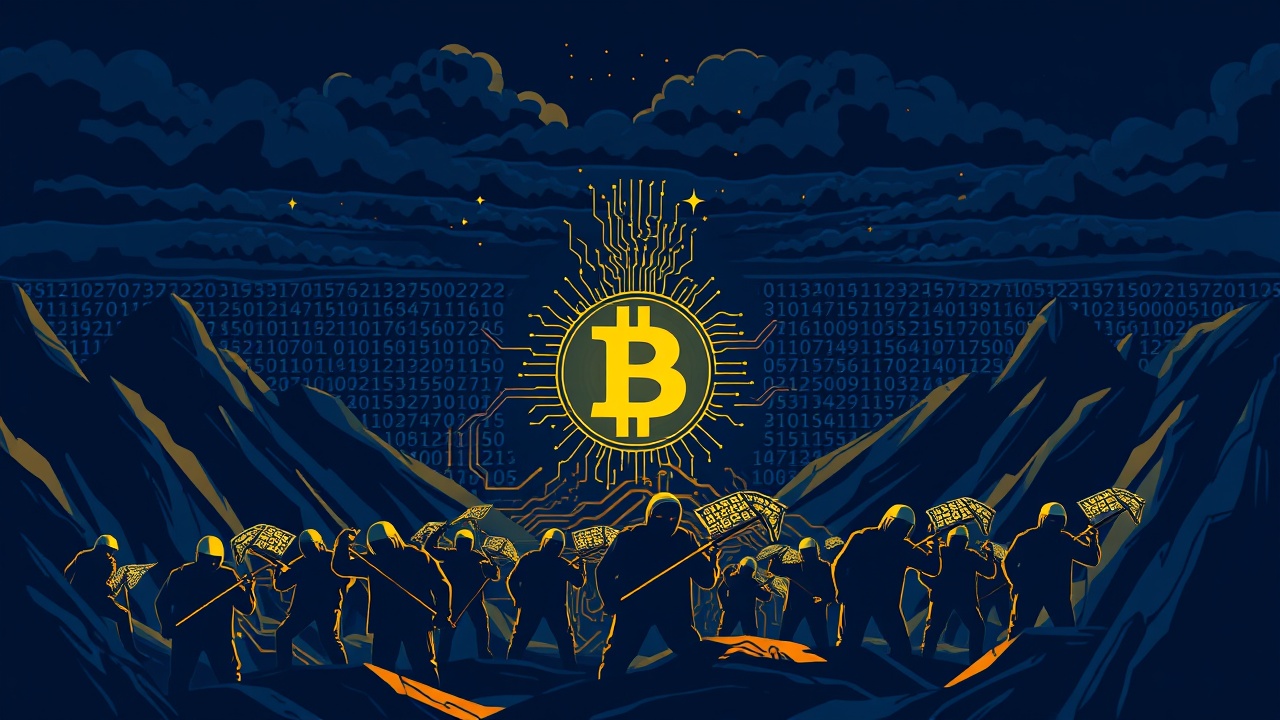
The Concept of Proof of Work
The concept of proof of work is pivotal in the functioning of Bitcoin, serving as its foundational consensus protocol. This mechanism compels computers on the network to expend a tangible amount of energy solving complex mathematical puzzles before they can append new transactions to the blockchain. It is this energy investment that not only supports the security and reliability of the Bitcoin network but also contributes to its substantial electricity consumption, which surpasses that of certain entire nations.
Understanding Proof of Work
Often, introductory explanations utilize analogies likening proof of work to a lottery, puzzle-solving endeavor, or competitive race. While engaging, these analogies can overshadow a crucial aspect: the principle behind proof of work is not the resolution of a problem per se, but rather the demonstration of resource expenditure in the pursuit of a solution. This distinction is vital as it elucidates the decentralized nature of Bitcoin; there is no central authority that dictates who can write the next entry on the ledger. Instead, the right to add entries is granted to those who exhibit the highest level of computational effort, which establishes the trustworthiness of the recorded history.
Technical Workings of Proof of Work
Utilizing a hash function like SHA-256, Bitcoin transforms inputs of varying lengths into a consistent, fixed-length output. Although this output appears random, it follows a deterministic pattern: the same input will always yield the same result, while even the slightest alteration in the input leads to a drastically different output. This phenomenon, known as the avalanche effect, is critical for the proof of work mechanism as it implies that there are no shortcuts to pinpointing an input that generates a specific hash. Attempting this involves countless trials, each carrying a minimal energy cost, with a very low probability of success.
When miners form a candidate block, they gather unresolved transactions and assemble a block header that includes metadata such as the hash of the previous block and a timestamp, along with a nonce field. They continuously hash this block header, increasing the nonce with each iteration, until the resulting hash meets a predetermined numerical threshold established by the network—the difficulty target. Adjustments in this target occur roughly every two weeks, enabling the Bitcoin protocol to maintain a consistent block creation time of approximately every ten minutes, adapting to fluctuations in network power as miners come and go.
Security and Economic Considerations
The protocol’s difficulty adjustment mechanism is ingeniously designed, allowing the network to self-regulate and ensuring consistent block arrivals, regardless of shifting miner participation. For instance, after a clampdown on Bitcoin mining in China, which effectively halved global hash power, the protocol adjusted the mining difficulty downwards, permitting the continued addition of blocks without delay. Conversely, as hash rates have migrated to countries like the United States and Kazakhstan, adjustments have increased accordingly.
In terms of security, proof of work creates a cost barrier for potential attackers. To alter Bitcoin’s transaction history, a malicious actor would need to redo the proof of work for every targeted block and simultaneously outpace honest miners to maintain the chain, a scenario referred to as a 51 percent attack. Critically, this endeavor is economically unfeasible: achieving such control would necessitate an overwhelming amount of mining hardware and significantly high ongoing electricity costs, among the estimated tens of millions per day.
Despite these substantial energy demands—which hover around 150 to 170 terawatt-hours annually, comparable to the consumption of entire countries—supporters argue that this expenditure secures a network valued at trillions. They assert that comparisons are appropriate not to the ideal of minimal energy use, but to that of traditional financial systems’ extensive infrastructure, which also consumes substantial energy.
Emerging Alternatives and Ongoing Debates
In contrast, the emerging proof of stake model has turned to collateralization in place of computation, requiring validators to lock up cryptocurrencies as stakes to propose blocks. This mechanism was adopted by Ethereum in September 2022, drastically reducing its energy usage and indicating a shift in security paradigms.
Discussions around the two methods remain unresolved; proponents of proof of work emphasize its physicality and resistance to censorship, while advocates for proof of stake highlight economic efficiency and reduced environmental impact. Both perspectives bring valid considerations to the forefront, shaping the debate around the future of blockchain consensus mechanisms.
Technological Advancements and Environmental Impact
As mining technology has advanced, starting from basic CPUs to specialized equipment like ASICs, the industry has witnessed an arms race among miners to deploy the latest, most efficient hardware. This ongoing evolution raises concerns regarding supply chain dependencies since a few manufacturers dominate ASIC production, which could pose risks to the decentralized nature of mining as envisioned by Bitcoin’s creators.
Furthermore, while criticisms of Bitcoin’s environmental footprint are widespread and not without merit, context is crucial. The cumulative energy use in the realm of Bitcoin mining, when compared to major industries and systems, illustrates a more complex narrative. The high percentage of renewable energy—estimated between 50 to 60 percent—utilized by mining operations reflects an evolving landscape where miners increasingly tap into underused energy sources.
Conclusion
While proof of work effectively ensures transaction order and integrity once confirmed, it does not safeguard against various threats like double-spending or human errors surrounding private keys. Its effectiveness lies in the preservation of transaction history rather than the validation of the transaction’s legitimacy itself.
As the Bitcoin community openly debates the sustainability of mining in the long run, what remains evident is the intricate interplay between technological advancements, energy consumption trends, and the underlying economic principles governing this digital monetary ecosystem. With Bitcoin mining resistance set to increase into the new year, the continued evolution of this consensus mechanism will undoubtedly captivate both industry enthusiasts and skeptics alike.