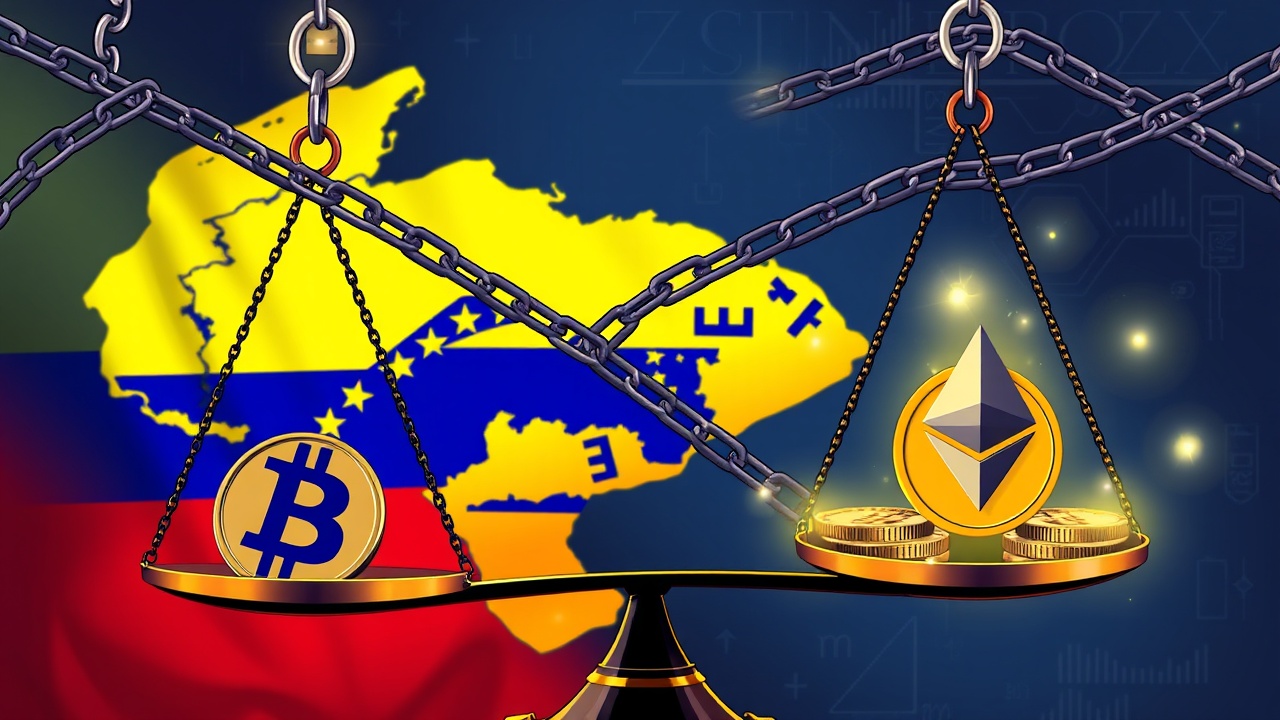
Venezuela’s Economic Turmoil and Cryptocurrency Adoption
As the United States and its allies ramp up efforts to destabilize the regime in Venezuela, a new analysis reveals that the nation has increasingly turned to cryptocurrency for economic survival. Over the past ten years, Venezuela has endured severe economic turmoil marked by impactful international sanctions and financial isolation, leading to a greater reliance on digital currencies, particularly Tether’s USDT stablecoin, according to recent findings by TRM Labs. The study highlights the unregulated crypto sector’s potential to facilitate Venezuela’s evasion of these international sanctions.
Impact of Sanctions on Financial Systems
Ari Redbord, who formerly served at the U.S. Treasury and is now TRM’s global head of policy, stated in an interview with Decrypt that prolonged sanctions and a decrease in correspondent banking significantly nudged both governmental and economic activities toward alternative financial systems. He described crypto assets as a double-edged sword for the Venezuelan populace—while they offer much-needed humanitarian support in a country lacking financial stability, they also present challenges for U.S. policymakers who aim to prevent cryptocurrency from becoming a method for evading sanctions.
Peer-to-Peer Trading and Regulatory Challenges
The report indicated that Venezuela has a burgeoning peer-to-peer crypto trading scene, often operating outside of traditional banking controls and featuring minimal know-your-customer (KYC) regulations. Notably, one peer-to-peer trading platform recently accounted for a staggering 38% of web traffic originating from Venezuelan addresses. Redbord noted that this informal trading, combined with certain hybrid financial platforms and fast-moving stablecoin transactions across various blockchains, creates an environment that’s conducive to circumventing sanctions.
Regulatory Landscape and the Petro
While Venezuela established a regulatory body for cryptocurrency, SUNACRIP, recent corruption issues and restructuring have undermined its authority over the digital currency landscape. Venezuela was also among the first countries to explore blockchain with the introduction of the Petro in 2018, a digital currency purportedly backed by the nation’s oil and mineral reserves. However, due to persistent controversy surrounding the Petro and its implications for the Venezuelan political scene, the token was ultimately phased out in 2024.
Geopolitical Tensions and U.S. Response
The geopolitical landscape surrounding Venezuela has intensified recently, with the Biden administration taking a more assertive stance. This week, President Donald Trump did not dismiss the possibility of military intervention as tensions rise. As part of this escalation, the U.S. government recently confiscated an oil tanker in a bold maneuver that further complicates the existing relationship between the countries.