Political Landscape and Bitcoin Taxation in Germany
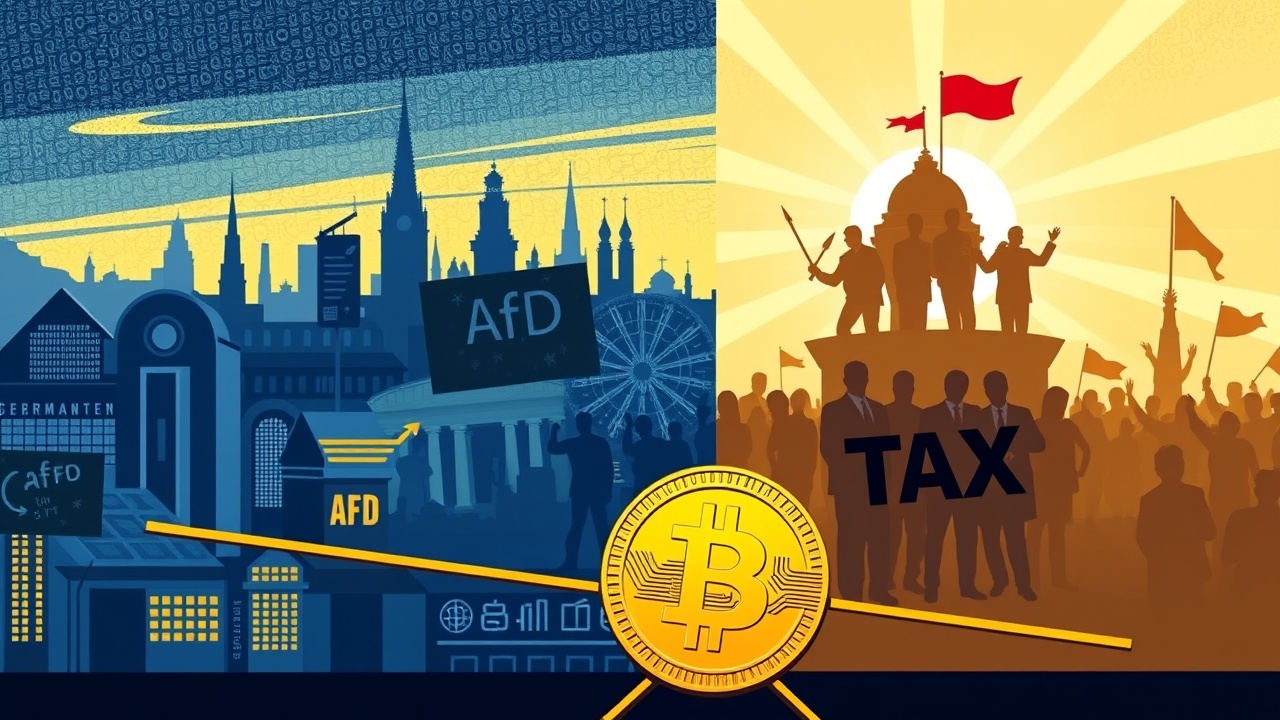
The political landscape regarding Bitcoin taxation in Germany has taken a noteworthy turn following the Alternative for Germany (AfD) party capturing nearly 44% of votes in the recent Saxony-Anhalt state election. This shift comes after the AfD previously opposed efforts to eliminate the country’s one-year tax exemption for cryptocurrencies.
According to Reuters, the AfD now holds 39 out of 83 seats in the state parliament, narrowly missing a majority by just three seats, and outperforming Chancellor Friedrich Merz’s Christian Democratic Union (CDU), which fell to a dismal 17.2% of party-list votes—reflecting a staggering drop of almost 20 percentage points from the 2021 election.
Voter turnout for this election reached an impressive 77.8%, up significantly from previous participation rates.
Implications of the Election Results
Although the election results do not grant the AfD any additional seats in the federal Bundestag, it does provide the party with a robust platform to advocate for their policies in the face of anticipated federal legislation that could reshape the taxation of long-term cryptocurrency gains starting in 2027. Merz has categorically ruled out any collaborative governance with the AfD, expressing that the election outcomes have deeply affected the CDU.
Conversely, AfD co-leader Tino Chrupalla has called upon members of the CDU to ally with the AfD to form what he refers to as a “center-right conservative majority.”
This proposal directly challenges the traditional political consensus in Germany, where mainstream parties have consistently avoided cooperation with the AfD due to its designation as a right-wing extremist party by the state’s domestic intelligence.
AfD’s Stance on Cryptocurrency Taxation
The AfD has long included crypto taxation within its economic framework, and after its Saxony-Anhalt triumph, it is emphasizing the need for specific treatments for Bitcoin. In an October 2025 Bundestag motion, the party characterized Bitcoin as a distinctive digital asset that should not be subject to the same regulations imposed on other cryptocurrencies.
They argued for preserving a 12-month holding period for privately owned Bitcoin, seeking exemptions for private mining and Lightning node operations from being classified as commercial activities.
Current Tax Structure and Future Changes
Currently, Germany’s tax structure assesses privately held cryptocurrencies in a similar manner to other assets, taxing gains made if held for one year or less. Any disposition after that period typically falls outside the taxable regime for private sales. The government’s intentions to reevaluate this tax framework were confirmed by Finance Minister Lars Klingbeil, who indicated the administration’s goal to initiate a legislative overhaul as part of the 2027 budget.
Since then, discussions have arisen, suggesting that these changes could align cryptocurrency income taxation with standard income tax rules.
Previous Proposals and Economic Impact
Earlier this year, the Green Party attempted to eliminate the holding period benefit altogether through a proposal aimed at subjecting crypto gains to personal income tax irrespective of the duration held. Advocating for this shift was a study from the Frankfurt School, which projected an additional €11.4 billion in potential revenue. However, this initiative was thwarted in the Bundestag Finance Committee.
Germany’s Position in the Cryptocurrency Market
Germany holds a prominent position in Europe regarding cryptocurrency activities, with Chainalysis estimating that in 2025, it generated around $24.1 billion in taxable on-chain crypto transactions—ranking second only to the U.S. The inflow of crypto into Germany has also surged, with $219.4 billion reported between mid-2024 and mid-2025, marking a 54% increase from the previous period.
As digital asset investment grows, a survey revealed that 25% of German investors have already ventured into cryptocurrencies, while nearly half expressed increased confidence in the security and accessibility of digital assets under the EU’s regulatory framework.