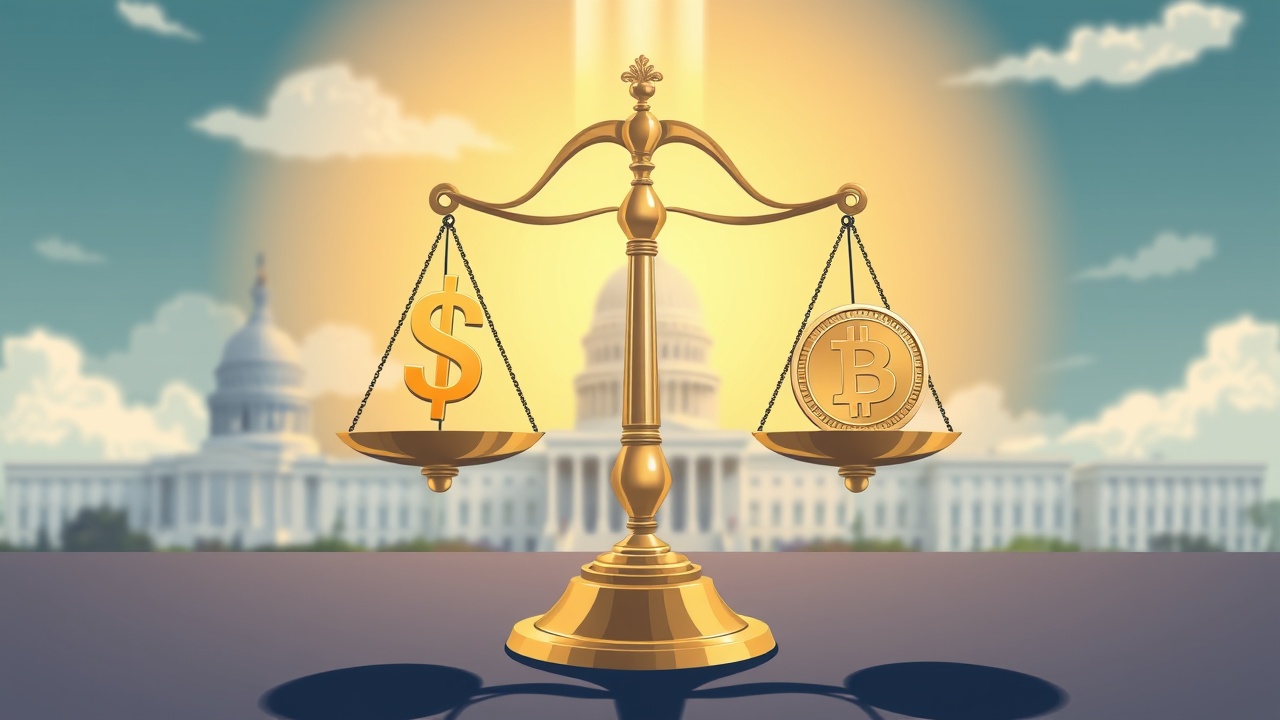
The Digital Asset Market Clarity Act: A Step Towards Regulatory Clarity
The Digital Asset Market Clarity Act has just overcome a significant committee hurdle, moving closer to potential enactment as law. This legislation aims to eradicate the longstanding confusion surrounding regulatory authority over cryptocurrencies in the United States. However, the final version that may reach President Trump for approval will be influenced by ongoing debates in the Senate, which will ultimately dictate winners and losers in the crypto landscape.
Understanding the Current Regulatory Environment
To illustrate the current regulatory environment, think of a restaurant operator caught in a duel between health and safety inspectors—each claiming jurisdiction without clear guidelines. A misstep can lead to severe penalties. This analogy mirrors how cryptocurrency companies have navigated the murky waters of U.S. regulation since around 2017. A protracted conflict between the Securities and Exchange Commission (SEC) and the Commodity Futures Trading Commission (CFTC) has left many firms uncertain about compliance, costing the industry billions in fines and driving many entrepreneurs to more favorable regulatory environments abroad.
Key Provisions of the CLARITY Act
The Digital Asset Market Clarity Act, or CLARITY Act for brevity, represents a concerted effort to clarify this gray area. Recently, on May 14, 2026, the Senate Banking Committee voted 15-9 to move the bill forward—the most decisive action yet in months of halted progress. Notably, two Democrats joined Republican colleagues in this vote, transforming the bill from an informal proposal to actionable legislation, raising questions among stakeholders about the implications of its passage.
At its core, the CLARITY Act simplifies classification by categorizing all digital assets into three distinct groups based on their unique characteristics and assigning regulatory authority accordingly:
- Digital Commodities – These are cryptocurrencies like Bitcoin and Ether, which derive their worth from a decentralized blockchain’s functionality. Such tokens would fall under CFTC jurisdiction.
- Investment Contract Assets – Tokens promoted via centralized fundraising efforts and tied to a specific project would maintain SEC oversight.
- Permitted Payment Stablecoins – Stablecoins pegged to fiat currencies, enabling practical transactions, would see both SEC and CFTC oversight, reflecting earlier legislative frameworks like the GENIUS Act.
This division could significantly illuminate the regulatory environment for various participants in the crypto sphere. The CFTC would gain exclusive control over digital commodities, a notable shift for an agency typically focused on derivatives rather than underlying assets. Additionally, it introduces a registration process specifically for exchanges, brokers, and dealers dealing with these digital commodities, moving them away from outdated securities regulations.
The SEC would retain its role over traditional securities, establishing a legal differentiation between the phases of token utilization—from initial investment contracts during fundraising to the eventual transition of a mature token into a commodity.
Protecting Innovation and Reducing Uncertainty
A pivotal provision in the act offers protection to developers who contribute to open-source projects without having custody over user funds, further legitimizing innovation in the crypto space. For developers, this means shedding the fear of legal repercussions simply for writing code, easing the stringent pressures that have previously stifled creativity in the sector.
For various stakeholders—developers, exchanges, and individual investors—this newly established framework promises a tangible reduction in regulatory uncertainty. Developers will no longer worry that public projects could expose them to legal challenges. Exchanges will operate under a clearer set of compliance requirements, transitioning away from uncertainties regarding asset classification. Token holders can expect better information transparency and enhanced protections from registered intermediaries.
Challenges Ahead
The bill’s most crucial battleground lies ahead, as three significant issues remain unresolved: clarity regarding ethics in government related to crypto dealings, measures to combat illicit financial activities using digital assets, and the fears of banks regarding yield-bearing activities related to stablecoins.
Democrats are advocating for an ethics provision aimed at preventing conflicts of interest within the government, particularly related to President Trump’s ties to the crypto sector. Simultaneously, certain lawmakers insist the bill needs to bolster anti-money laundering measures to prevent its potential misuse.
Additionally, concerns from the banking sector regarding stablecoins suggest a deeper financial struggle, as institutions worry about deposits migrating to yield-bearing digital alternatives.
Looking Ahead
Upcoming negotiations will combine the Senate Banking Committee’s legislation with related discussions in the Senate Agriculture Committee to forge a consolidated text for a vote. Beyond that, any bill passed must also be reconciled with a version from the House before reaching the President.
Looking ahead, while proponents of the bill express optimism regarding its passage, experts urge caution as the approval process faces intricate negotiations. Ultimately, the CLARITY Act could signify a pivotal moment in defining how cryptocurrencies are regulated in the U.S. for years to come, striving not for a paradise of lawlessness, but for a structured map guiding participants through a once murky reality.