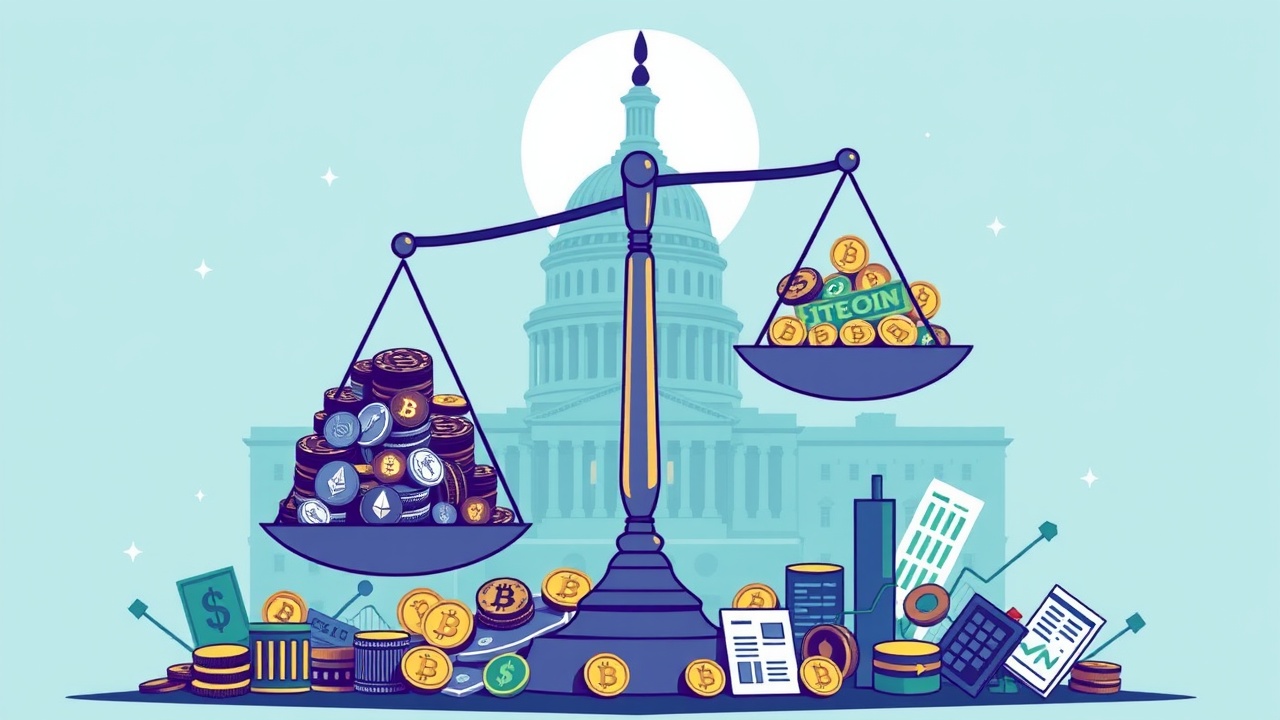
Upcoming House Committee Session on Cryptocurrency Tax Legislation
On September 16, the House Ways and Means Committee is set to hold a session focused on two proposed pieces of legislation that could significantly alter the tax landscape for cryptocurrency miners, stakers, and traders in the United States. This review, however, has raised uncertainties, as the official markup notice was still absent from the committee’s public calendar as of September 14, leaving details about the session, including the time and confirmed bills for discussion, unclarified.
Proposed Legislation Overview
The bills under consideration, known as H.R. 9175 and H.R. 9172, tackle different aspects of the tax code. H.R. 9175 proposes a system that permits eligible individuals to defer tax liabilities on mining and staking rewards until they are sold. In contrast, H.R. 9172 seeks to apply existing regulations about wash sales and constructive sales to digital assets, a move that could align cryptocurrency transactions more closely with traditional financial properties.
Introduced by Representatives Mike Carey and Jodey Arrington on June 8, both measures aim to establish clearer tax guidelines for American taxpayers engaging in digital assets, as asserted by Committee Chairman Jason Smith. He expressed that the current tax framework has not adapted adequately to recent advancements in financial technology. The committee had previously conducted a legislative hearing addressing these proposals along with other related tax measures, featuring expert testimonies from major industry players including Fidelity and Coinbase.
Details on H.R. 9175 and H.R. 9172
While there have been reports suggesting potential revisions to the mining tax deferral—particularly a limit to five years or its total removal—no official amendments have been documented as of the latest updates. H.R. 9175 lays out two tax treatment approaches for qualifying tokens born from acceptable processes like mining or staking. The primary rule stipulates that taxpayers would report the market value of such tokens as ordinary income upon acquisition. However, taxpayers could also choose to postpone this recognition under certain conditions, opting to defer the taxable gain until the token is sold.
Meanwhile, the predicted fiscal impact of H.R. 9175 suggests it could lessen federal revenues by nearly $3 billion over a decade, according to the nonpartisan Joint Committee on Taxation. The second measure, H.R. 9172, aims to expand tax anti-abuse rules to include digital assets, potentially providing more structure regarding how losses on trades can be deducted by buyers and making provisions for the treatment of stablecoins and other specific contracts.
Legislative Process and Future Outlook
Originally, the House committee’s markups are designed to facilitate discussions and potential amendments before votes on the proposed legislation. However, even if these bills pass through the committee, they still face the uncertainty of wider approval within the full House and may ultimately undergo additional revisions if they are taken up by the Senate, where the decision-making process can diverge markedly. As it stands, no formal text for potential alterations has been published, leaving the fate of these bills temporarily suspended until the committee issues any further instructions or notices ahead of the scheduled markup.