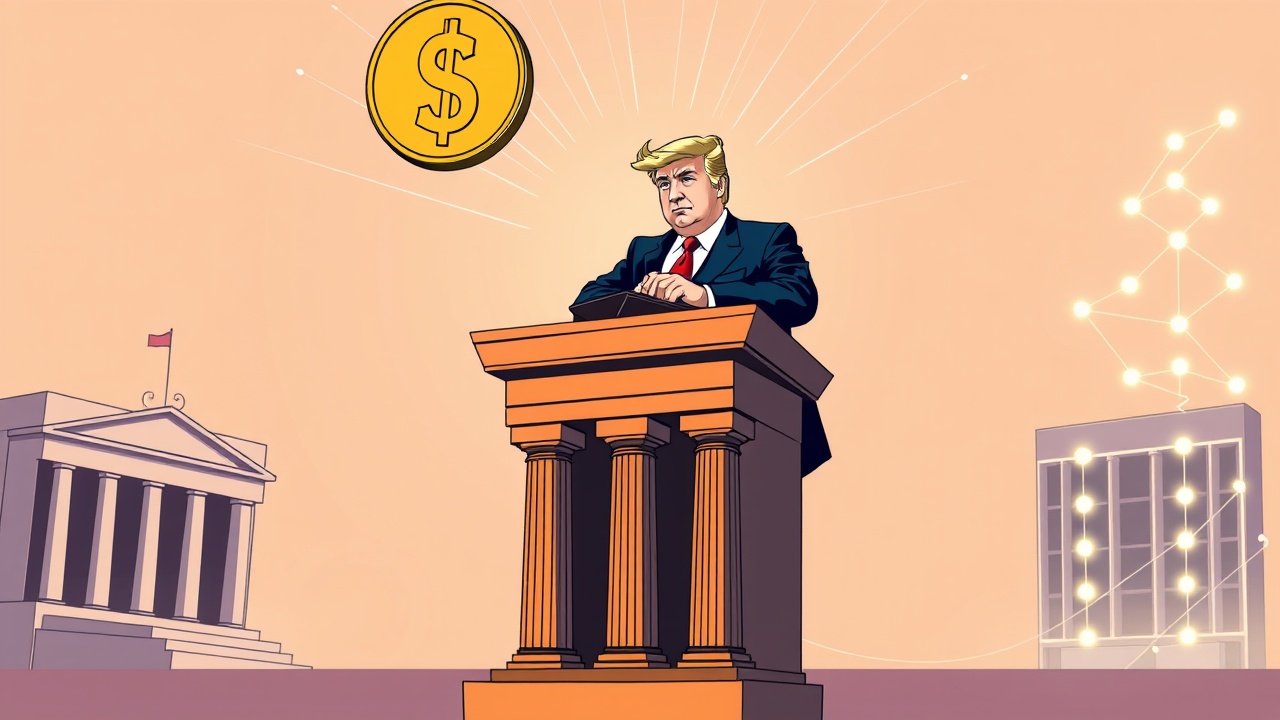
Executive Order on Financial Technology Regulations
U.S. President Donald Trump has mandated a reassessment of the Federal Reserve’s policies concerning the accessibility of its payment systems for financial technology (fintech) and cryptocurrency companies. This move comes as part of a new executive order aimed at modernizing financial technology regulations. The order, unveiled on Tuesday, is designed to encourage federal agencies to eliminate regulations that may pose unnecessary hurdles to fintech firms engaged with digital currencies and blockchain technologies.
Federal Reserve’s Evaluation of Payment Services
Specifically, the executive order instructs the Federal Reserve to undertake a detailed evaluation regarding access to payment services and accounts typically governed by Reserve Banks. This review will determine if current regulations can be adapted to allow fintech and crypto businesses, which historically have been excluded from such privileges, to gain direct access.
Traditionally, depository institutions with proper licenses are the ones that obtain these accounts, which has led many cryptocurrency businesses to seek banking charters as a workaround. The executive order further asks the Federal Reserve to clarify the autonomy of its 12 regional banks in granting or denying access to these master accounts. Master accounts would enable crypto firms to directly engage with payment systems like Fedwire, streamlining dollar transactions without the need for intermediary banks.
Recent Developments and Industry Reactions
The urgency of this examination has intensified following the Kansas City Federal Reserve’s recent approval of a limited-purpose master account for Kraken, a prominent cryptocurrency exchange’s banking arm, Kraken Financial. This designation allows Kraken to interface directly with U.S. payment systems for high-value transactions. According to Kraken’s co-CEO, Arjun Sethi, this access represents a significant overlap between cryptocurrency infrastructure and traditional financial systems.
“This access represents a significant overlap between cryptocurrency infrastructure and traditional financial systems.” – Arjun Sethi
However, the approval of such accounts is not without restrictions, as institutions can connect to payment systems but are ineligible for interest on reserves or borrowing from the Federal Reserve’s discount window. Following the public announcement of this decision, various banking organizations expressed their strong opposition. The Independent Community Bankers of America voiced significant concerns regarding a crypto-based entity’s access to Federal Reserve resources under a different regulatory paradigm from that established for conventional banks.
Additionally, the Bank Policy Institute criticized the Kansas City Fed for issuing what it termed as a “skinny” version of a master account before the Federal Reserve had completed its policy for these arrangements. There were also worries about Kraken Financial’s operating status as a Wyoming Special Purpose Depository Institution (SPDI), which lacks the federal insurance that typical banks possess. Banking groups warned that granting these uninsured entities direct access could lead to risks related to compliance and financial stability.
Future Legislative Support
In December, the Federal Reserve proposed a framework for issuing limited-purpose master accounts. This framework would permit entities to connect with the payment systems while limiting the full range of benefits typically available to banks. Legislative support for expanded access has also been seen in Congress, where Representatives Sam Liccardo and Young Kim proposed the PACE Act. This proposed legislation aims to facilitate access to Federal Reserve payment services for select non-bank providers, a proposal that has garnered backing from various crypto industry advocates as a means of better integrating digital asset firms into the U.S. financial ecosystem.