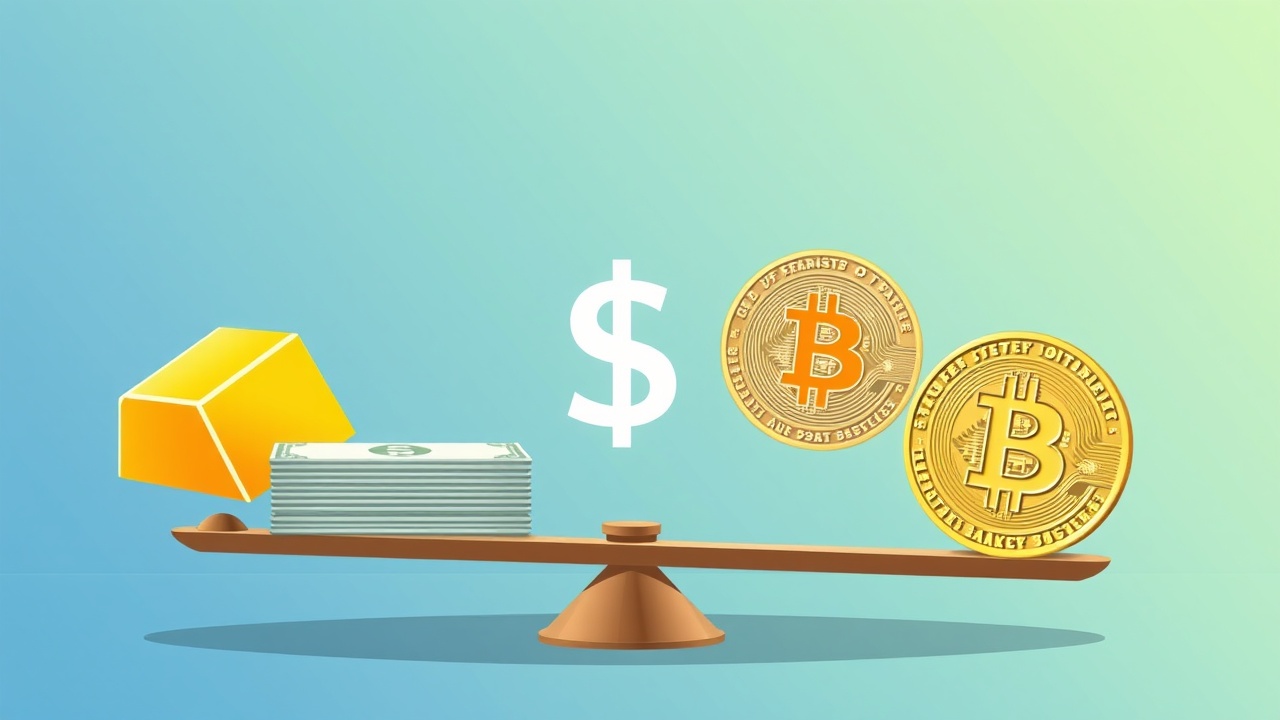
Understanding Safe-Haven Assets
Safe-haven assets are investments known for their ability to maintain value or outperform riskier assets amid significant market turmoil. These types of assets do not necessarily need to gain in value whenever stocks decline; rather, they should exhibit little to no correlation or a negative correlation with riskier investments during market distress, according to the International Monetary Fund (IMF).
Traditional Safe-Haven Investments
Gold, U.S. Treasuries, and the U.S. dollar are often cited as traditional safe-haven investments. In recent discussions, Bitcoin has also emerged as a contender in this space, albeit with more erratic patterns compared to the more established assets.
The Role of Gold
Gold stands out due to its nature of not being a liability of any institution—its value is not tied to the performance or solvency of a company, bank, or government. This characteristic contributes to its long-standing status as a preferred reserve asset. The World Gold Council indicates that reserve managers utilize gold for its capital preservation qualities, diversification, and liquidity, especially in times of financial stress.
Gold tends to perform exceptionally well when concerns about inflation, currency devaluation, geopolitical risks, or systemic financial issues arise. However, it’s essential to note that gold is not an infallible buffer against all short-term market losses; it can decrease in value when real yields experience a significant uptick, making interest-bearing assets more attractive.
U.S. Treasuries and the Dollar
For more insight, our detailed analysis of gold and Treasuries breaks down how each of these assets provides protection against specific types of financial risks. U.S. Treasuries are frequently regarded as core safe assets due to the depth and liquidity of the Treasury market, typically performing well during economic downturns. When anticipations arise that the Federal Reserve may lower interest rates, the prices of existing long-term Treasuries generally increase as their yields decrease. Moreover, Treasuries offer interest payments, a feature that gold lacks.
The U.S. dollar, similarly, benefits from investors’ shift to safety in times of financial stress where there is heightened demand for dollars to satisfy liabilities, hold cash, or purchase dollar-denominated assets. However, neither Treasuries nor the dollar serves as a foolproof hedge; for instance, the value of long-term Treasuries can plummet in an inflationary environment, while expectations of aggressive interest rate cuts may weaken the dollar.
Bitcoin as a Safe Haven?
Understanding real yields is crucial for assessing bonds in comparison to non-yielding assets like gold. On the other hand, Bitcoin possesses attributes that bolster the argument for its designation as “digital gold“. With a capped supply of 21 million coins and independence from central banking systems, Bitcoin allows for global transfers without reliance on traditional banking infrastructures. Nevertheless, its market performance can resemble that of high-risk technology assets in downturns, an observation highlighted by Coinpaper’s research indicating Bitcoin’s short-run correlation with tech stocks, which raises questions about its reliability as a stable safe haven.
Furthermore, Bitcoin’s price volatility exceeds that of traditional safe-haven assets like gold or Treasuries. As a result, while Bitcoin might be viewed as a long-term alternative for value retention, it is less reliable as a short-term safeguard during crises.
Conclusion
Therefore, rather than seeking a single “safest” asset, it is more beneficial to recognize that different types of safe havens are adept at protecting against various risks—investors might favor Treasuries during recessions, gold in inflationary periods or geopolitical tensions, the dollar in liquidity crises, and Bitcoin as a dynamic and evolving asset in a portfolio.