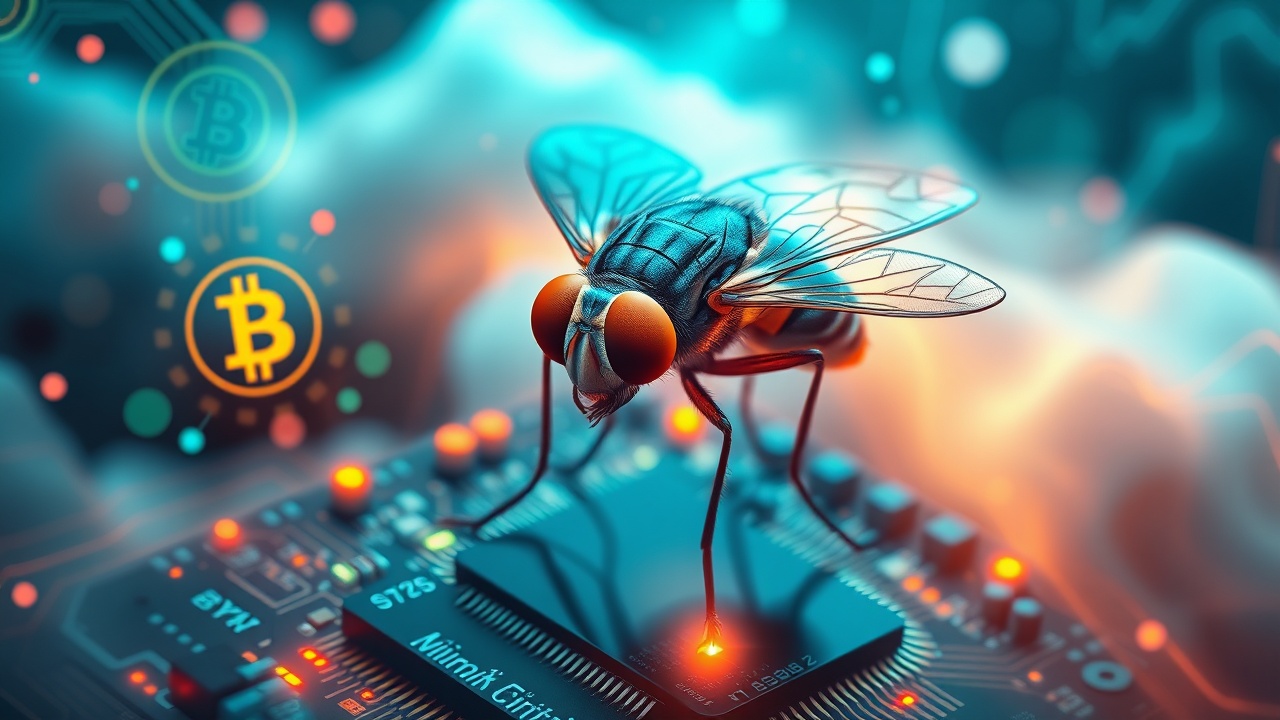
Revolutionizing Bitcoin Mining with Biological Insights
In a fascinating experiment aimed at revolutionizing Bitcoin mining, tech firm FutureBit has developed a method that utilizes a simulated fruit fly brain, claiming it may offer unprecedented energy efficiency. This innovative approach, known as HashFly, replicates the behavioral patterns of 2,914 neural pathways extracted from MaleCNS v1.0, which outlines the wiring of an adult male fruit fly’s brain and central nervous system.
Ambitions and Potential of HashFly
FutureBit shared its ambitions on social media, stating that they intend to eventually model all neurons in their dataset using SHA-256, a cryptographic hash function. They noted that if this concept could be applied to actual living neurons, it could achieve a hashing power estimated at around one watt per terahash—significantly outperforming the current best silicon 3nm ASIC miners, which require substantially more power for the same output.
This hypothetical scenario suggests that a specialized system leveraging biological neurons could theoretically execute one trillion calculations per second, while only using one watt of energy, thus showcasing an efficiency roughly ten times greater than that of leading ASIC technology. However, it’s important to clarify that this experiment is conducted on standard computer systems, and its current performance does not enter into serious competition with established Bitcoin miners.
Efficiency in Bitcoin Mining
In the Bitcoin mining landscape, efficiency is measured by hash rate, which quantifies how many calculations are performed per second in a race to validate transaction blocks. FutureBit’s HashFly allows users to set mining targets but operates at a substantially lower difficulty level compared to existing Bitcoin challenges; to compare, the company’s Apollo III ASIC miner, which is just five inches in size, achieves a hash rate of approximately 18 terahashes per second.
Complementary Initiatives
Complementing this research, another initiative dubbed FlyMiner employs a more extensive digital framework featuring a map containing 139,255 fruit fly neurons and 16.8 million synaptic connections to command a traditional Bitcoin mining operation. In this setup, when the simulated signals indicating movement from the fly’s brain surpass a certain threshold, the software engages in testing various potential solutions to a mining challenge, capable even of reaching up to 700,000 computations per second.
Emerging Trends in Bitcoin Mining
These fruit fly-focused projects represent just a few examples within the larger trend of unconventional strategies emerging in the Bitcoin mining arena. In March 2021, a security expert managed to adapt a 1989 Nintendo Game Boy into a Bitcoin miner, which achieved around 0.8 hashes per second. More recently, in June 2023, a bathhouse in Brooklyn started channeling the heat output from mining rigs into their swimming pools, while Utah’s Nodal Power raised $13 million in August 2023 to enhance operations that extract electricity from landfill methane for Bitcoin mining purposes.