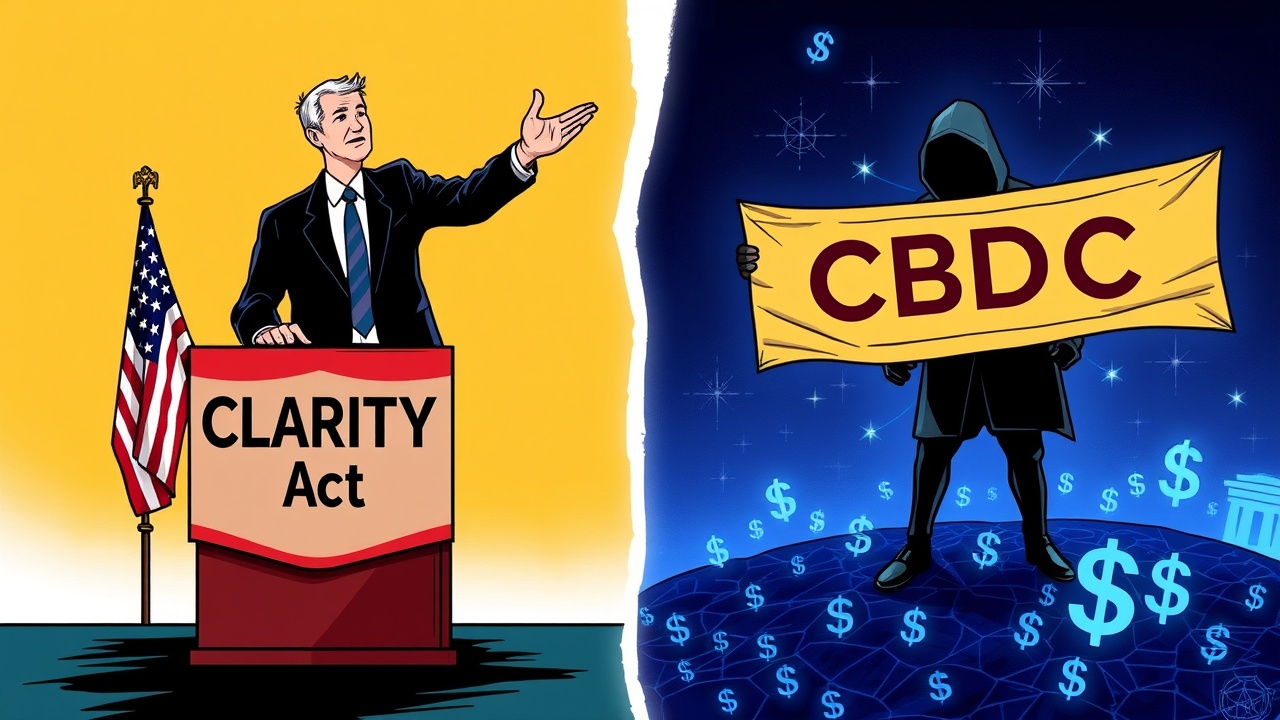
U.S. Treasury Secretary’s Stance on CBDC
In a recent press briefing at the White House, Scott Bessent, the U.S. Treasury Secretary, strongly emphasized the Trump administration’s stance against the establishment of a Central Bank Digital Currency (CBDC). Bessent articulated that a CBDC is decisively “off the table,” prioritizing instead the implementation of legislation to create a more transparent regulatory environment for digital asset businesses within the country. He underscored the administration’s aim to foster innovation in the digital assets sector, indicating that it’s crucial for the U.S. to retain these businesses domestically.
Republican Party’s Resistance to CBDCs
Bessent’s comments reflect a broader narrative within the Republican Party, where resistance to a U.S.-issued digital dollar is fortified by concerns over government tracking and reduced privacy in financial transactions. Earlier in the month, Congressman Mike Flood pointed out that House Republicans successfully amended the Senate’s version of the 21st Century ROAD to Housing Act, removing a clause that would end restrictions on CBDCs in 2030, which they fear might facilitate the adoption of a government-backed digital currency in the future.
Furthermore, other prominent Republicans, like Representative Warren Davidson and House Majority Whip Tom Emmer, have voiced their opposition to CBDCs as well, expressing skepticism about the implications of such currencies for financial privacy. Davidson highlighted that the sunset clause could set the stage for future CBDC development, while Emmer has championed the Anti-CBDC Surveillance State Act aimed at permanently banning the Federal Reserve from issuing a digital currency.
Bessent’s Advocacy for Digital Asset Regulation
During his tenure, Bessent has consistently shared these concerns. In his nomination hearing held in January 2025, he remarked that pursuing a CBDC was unnecessary for the U.S., particularly as global interest may be more pertinent for nations with fewer investment options. His latest advocacy calls for Congress to expedite the passage of the CLARITY Act, which aims to provide a structured legal framework for digital assets.
Despite some legislative progress, including bipartisan support for the GENIUS stablecoin bill, the future of such regulations remains uncertain, with banking associations and crypto industry stakeholders still in discussions regarding stablecoin yield-bearing products. In an opinion editorial featured in The Wall Street Journal, Bessent urged Congress to act swiftly on the matter, pointing to a burgeoning digital asset market valued at approximately $3 trillion, which has seen a significant portion of the American populace investing in digital currencies.
Former President Trump’s Support
Additionally, former President Trump reiterated his support for developing a robust framework for digital assets, intending to shield the market from what he terms as “crypto haters.” As various proposals related to digital asset regulation are under consideration, Congress finds itself navigating a complex landscape where discussions around market structure, stablecoin regulation, and CBDC limitations are increasingly intertwined.